Showing posts with label Barcelona neighborhoods. Show all posts

Sunday, December 28, 2008

Sunny Barcelona? Often, but certainly not always!

In all my time in Barcelona, I had never seen the local beaches closed until recently. The city has partitioned off all local beaches due the worst storm to hit the Catalan and Valencian coast in 50 years. On Christmas day the weather was typically lovely -- sunny, clear and bright. Then by the night of the 25th everything changed!

The rain started Thursday evening, eventually accompanied by very strong winds. That night I could feel the building I live in swaying! The storm was so bad on Friday that I stayed in all day. The awful weather continued on Saturday morning, but calmed down later in the day. When I walked to the seafront that afternoon I was shocked by what I saw: objects large and small strewn across the sand, restaurant terraces destroyed, and police tape running along the beach to block entry. (See the incredible photo slide show on the El Periodico web site; photos 4 and 5 were taken at Barceloneta beach, with the high rise buildings of Port Olimpico in the background. The photo above is of Bogatell beach, which is on the other side of Porto Olimipco.)

Saturday night there was a light rain when I went out, but by the time I came home storm conditions had returned. I have never seen the Mediterranean's waves crashing so hard and the only times I have ever felt such strong winds were during hurricanes.

The result of this awful weather is that businesses and homes suffered damage from wind and water, rail service was interrupted, traffic problems abounded and some individuals even lost their lives. So far, four people have died as a result of the inclement weather on the coast, including a Port Olimpico worker who was swept away by a wave. Two other people were killed when their cars were washed away by waves! The fourth person died while scuba diving near Valencia when the storm hit. (I think the storm hit there a little earlier in the day than it did in Barcelona.) Of course, there were also many injured people.

As I write this on the night of Sunday the 28th, it's not raining at the moment, but the skies are still covered with clouds and the weather forecast is for storm conditions to return.

Oh, what a Christmas!

Saludos amig@s,

Carloz

Sunday, December 14, 2008

Barceloneta's La Fraternitat


Aside from Barcelona's public library system being excellent, many of the neighborhood libraries are located in interesting buildings. Some of these are in attractively designed new structures, whereas others are in historically significant buildings. The library in my neighborhood is an example of the latter.

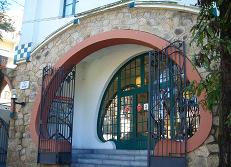
As you can see from the photo, Barceloneta's La Fraternitat library is in a lovely old building. Its interior has been remodeled to adapt to the needs of a modern community resource, while its facade has been restored to its Art Nouveau grandeur.

Although no one seems to know exactly when the original building was constructed, undoubtedly its foundations were laid out when Barceloneta was begun in 1753. Like the other neighborhood buildings of the time, it would have had only one or two stories, since taller structures were not allowed in the district until the 19th century.

What is known is that in 1879 a progressive workers' organization called the Cooperativa Obrera La Fraternitat (The Fraternity Workers' Cooperative) began operating in Barceloneta. It initially ran a low-cost neighborhood store for workers and their families, and eventually developed into a social and cultural center that included a library.

In 1910 the cooperative moved to the building which today is known as La Fraternitat. In 1917 remodeling of the edifice was begun by the architect Francesc Guàrdia i Vial, who was a disciple of Barcelona's Lluis Domenech i Muntaner and Vienna's Otto Wager. The following year the work was completed and the cooperative's headquarters inaugurated.

At that time the ground floor held a neighborhood store and bodega, the first floor, a cafe and library, the second floor, an assembly hall, and the third floor, a boardroom and offices. The cooperative continued to offer services there until 1974. Eventually a savings bank took over part of the space, while the rest of it fell into disuse.

In 2001 the city of Barcelona converted the building into a public library. Initially only a small portion of the ground floor was used as a little lobby, with the upper floors housing the library itself. While it was a very nice, modern library, the majority of the bottom floor was inaccessible and dull concrete slabs filled in the spaces where large windows once looked out onto the street.

Then last year local architects Josep Maria Rovira, Orlando González and Antoni Soler used Guàrdia i Vial's original plans to reconstruct the main floor. As a result the facade has regained an open, inviting appearance. The ornate building's Doric columns and exposed brick exterior once again frame large windows, that today pour natural light onto the library's ample public reading area.

It's a beautiful spot to visit for residents and tourists alike.

La Fraternitat Public Library
C/ Comte de Santa Clara, 8-10 (on the corner of C/ Sant Carles)
Barceloneta
Tel: 93 225 35 74

Autumn, Winter and Spring Opening hours:
Mondays, Wednesdays and Fridays 15:30 – 20:30
Tuesdays 10 – 14 and 15:30 – 20:30
Thursdays 10 – 20:30
Saturdays 10 – 14

Summer Opening Hours:
Mondays, Wednesdays and Fridays 16 – 21
Tuesdays 10 – 14 and 16 – 21
Thursdays 10 – 21

Ciao amig@s,

Carloz

Saturday, November 15, 2008

A sample of things to do in Barcelona for 5 euros and under


There are always cheap things to do in Barcelona, including some that are free. For example, the web site BarcelonaGratis.com provides up to date listings of free activities, including exhibitions, concerts, festivals, cinema, sports, children's events, etc. (By the way, the site is only available in Spanish.) It also maintains a list of the days of the month when local museums offer free admission. (Most museums in Barcelona are free on the first Sunday of each month, but a few are free on other days. Check the list for details.)

And believe it or not, it is still possible to find a full meal for 5 euros -- at least one day a week, that is! I noticed recently that Charleston's, one of the restaurants on Paseo Joan De Borbon, now has a 5 euro lunch menu on Fridays; the rest of the week it's 8.50, which is still a good price. As I mentioned in an earlier post, don't let the name Charleston's fool you, as it's Spanish food that's on offer there -- although, no paella.

Charleston's
Paseo Joan de Borbo, 2
Barceloneta
Barcelona
Open from 7h to 22h daily

For more examples of free and low cost things to do in BCN, below is a list of things to do on the weekend I am writing this. It's taken from an article in today's La Vanguardia newspaper called: 10 Citas culturales por menos de 5 euros. (10 cultural events for less than 5 euros.) Here's my translation of the listings in the article:

-Free-

Raval Culture Festival
a hundred or so neighborhood organizations offer a constellation of activities all weekend long. Concerts ranging from gospel to Pakistani music, hip-hop to Brazilian batucada. Photography expositions, too. Sunday Nov. 15th at 16.30h a series of videos made by residents on the topic of the Raval neighborhood will be shown at the CCCB. Through Sunday. http://www.totraval.org/

Joan Petit in concert
Mallorcan singer / musician Joan Petit in concert at Heliogabal Musical Bar. Petit, who worked with the British group The Wedding Present in 2006, is on the verge of releasing his first CD. Saturday the 14th at 22h. www.myspace.com/welovepetit ,

Macba Collection
Macba exhibits 17 works of minimalist artists, their influencers and some they've influenced, including Buren, Wharol, Flavin, Mangol, Bell, Sonnier, Haacke, Saws, Matta-Clarck. The video artist John Baldessari adds a brushstroke of humor to the exposition space through his video "Baldessari Singing". http://www.macba.es/

Transglossador Slam Festival
The art of improvisation to music is not the unique providence of Rap and Hip-hop. Artists such as Abd The Malik can slam to a Brel song. The third Transglossador Slam Festival offers slam workshops, as well as performances and improvisations of various of groups, such as De Caláis and Rapsodes. Saturday from 18,30. http://www.farinera.org/

La Felpa
BTOY Exposition
Ilia Mayer and Andrea Michaelsson, two art illustrators, with exhibitions at the BAC (Barcelona Art Contemporaneo) show their their work in Gracia's La Felpa on Saturday from of 12.30 to 21.30. http://www.thisisbtoy.com/

-4 euros-

American Modern at the Joan Miró Museum
A showing of works by more than one hundred 20th century American artists, including George Bellows, John Singer Sargent, Arthur Davies, Marsden Hartley, Joseph Cornell, Thomas Hart Benton, John Sloan, Edward Hopper, Milton Avery, Mark Rothko, Willem of Kooning, Cy Twombly, Richard Diebenkorn, Martin Puryear and Robert Mangold.

-4.10 euros–

Palau de La Virreina
De facto: Joan Fontcuberta 1982-2008 -- photography as documentation.
A sample of 50 of the photographers images at the Palau of the Virreina. The photos are somewhere between documentary and fiction, with humanist and philosophical inspiration. Until February 8. www.bcn.cat/virreinacentredelaimatge/castella/home.htm

-4.50 euros-

Ciné Mélies
Several movies showing in the original language with Spanish subtitles. One movie now playing is L'Heure d'été (Las horas del Verano / Summer Hours), directed by Olivier Assayas; starring Juliette Binoche, Charles Berling, and Jeanne Balibar, who won the best actress award at this past September's San Sebastian Film Festival. http://www.cinesmelies.net/

CCCB Independent Film Festival
More than 78 movies from 33 countries. http://alternativa.cccb.org/2008/ct/

-5 euros-

Mostra de Teatre del Raval (Raval Theatre Presents)
The Raval Theatre itself is the epicenter of this festival, with 15 plays selected for presentation. This weekend a play by children for adults premieres: "Un día, una hora..." is based on numerous stories told by children to Argentine Javier Villafañe in 1980s. Until December 7. http://www.mostradeteatredebarcelona.com/

Disfrutadlo amig@s,

Carloz

Monday, May 12, 2008

Dancing in the Street at Second Easter Time


Today is a public holiday in Barcelona – Lunes de Pascua Granada, which literally translates as something like, “Fructifying Easter Monday.” However, it is commonly called Lunes de Segunda Pascua, which is more easily translated into, "Second Easter Monday." In the English speaking world it's known as the day after Pentecost, or Whit Monday. Aside from Barcelona, this day is observed as a holiday in a few other parts of Spain, such as Valencia and the Basque Country, as well as in several European countries, including Belgium, Denmark, the Netherlands, Norway, Poland and parts of Austria, Germany, Hungary and Switzerland...

To read more, go to the updated post here

Wednesday, August 15, 2007

From the seaside to the hillside - Part 3 (Vallvidrera)

In my opinion, Vallvidrera, which is perched on the crest of the Collserola hills above Barcelona, is one of the city's loveliest neighborhoods. To get there, I usually take the FGC from Plaza Cataluña. (FGC stands for Ferrocarrils de la Generalitat de Catalunya, which is the name of the Catalonian government railway system. Within the city, FGC trains run underground, but outside the city they climb out into the light. Barcelona's transportation system is completely integrated as far as fares and tickets go. So, a pass for the metro is also a pass for the FGC.)
.
Directly in front of Café Zurich are two entrances to the underground Metro and FGC stations. From either of these two entrances one can enter the FGC station. To get to Vallvidrera take any FGC train except the one to Av. Tibidabo. There are television screens throughout the station indicating when and from which track the next train leaves. Since there are trains leaving every few minutes, it's usually possible to hop on a train immediately. I've never had to wait more than about 5 minutes.
.
After a short ride, it is necessary to get off the train at the Peu del Funicular station and transfer to the modern little funicular that goes up to Vallvidrera. This funicular station is located in an area known as Lower Vallvidrera (Vallvidrera Inferior). The transfer is easy and fast at this little open-air station; and the ride up the hill, in metal and glass cable cars manufactured in Switzerland, offers some excellent views of the city and sea below. The best views are from the seats in the back of the car.
.
The funicular's hours are 4:30am to 12:15am weekdays and 5:30am to 12:45am weekends and public holidays. Cars run every 6 minutes on weekdays and every 10 to 15 minutes on weekends and public holidays.
.
Although one wouldn't know it from the sleekly contemporary appearance of the Peu de Funicular station and cable cars, this line has been in operation since 1906, when the rail line was extended from Sarrià to Lower Vallvidrera. It wasn't until 1998 that the funicular was converted into the totally automated system it is today.
.
There is only one stop between Lower and Upper Vallvidrera: the tiny Carretera de las Aguas (Water Road) station. At this stop it is common to see hikers and bicyclers getting out. However, I usually prefer to ride to the top and then walk down to the Carretera.
.
Next comes Upper Vallvidrera and a fantastic remnant of the 1906 line -- the modernist art nouveau Vallvidrera Superior station. Walking around this little jewel of a station, with its voluptuously curved windows and entrance, is like stepping back in time to the era of Gaudi. Constructed in 1905, the station was designed by the architect Bonaventura Conill i Montobbio, who who designed a good number of the buildings in Vallvidrera. Make sure to visit the viewing platform at the back of the station's lobby.
.
From here it is possible to take a city minibus (line 111) to the top of Mount Tibidabo, where a large church sits on top of an amusement park overlooking the city. Since Vallvidrera is actually surrounded by the protected Collserola Natural Park, it is also a great place to start off for a hike in the woody hills. Before doing anything else, however, get to know this quaint little neighborhood a bit.
.
The earliest known reference to Vallvidrera appeared in 987, in a document referring to the church of Santa Maria de Vallvidrera and a Gothic style church by that name was built between 1540 and 1587, and is located in what today is the park of Collserola. In the 14th century the "parish" became a "civil jurisdiction." In 1892, what was then the town of Vallvidrera was annexed by the town of Sarrià, which was then annexed by Barcelona in 1921.
.
Despite this long history, major urban development didn't begin in Vallvidrera until the second half of the 19th century, when the characteristics of the area a¡changed from that of a village to a location for summer homes of the increasingly prosperous citizens of Barcelona. A "modern" road was not built to link it with the city until 1888, when the Vallvidrera to Tibidabo roadway was constructed. In 1901 a tram was inaugurated to link Barcelona, Tibidabo and Vallvidrera. In 1906 the funicular connected the area with Sarria. At this time Vallvidrera became a popular summer residence for wealthy Barcelonans. Today it is a handsome residential neighborhood with the characteristics of a small, prosperous town.
.
Directly across from the funicular station is Plaza Pep Ventura. Walking around the little square and the streets surrounding it, one is surrounded by superb views. Walk to one side of the plaza and gaze over the tiled roofs of lovely little houses out onto the green valley below and the Montserrat massif looming in the west. Most of the houses date to the early 1900s, as can be observed by the years inscriptions on the gables. (One house even has a Catalan poem inscribed on it!)
.
Head to the the east along C/ de Queralt, which changes from a street to a series of pedestrian steps. Look between the houses to the left for some great vies of the city. At the foot of the steps you will find the main square of the neighborhood, Plaza de Vallvidrera. Stop in at for a coffee and a sandwich at Bar Josean, which has a back sitting room with an incredible view of Barcelona and the Mediterranean. Nearby, the Can Trampa restaurant doesn't offer much of a view but is a good little spot for lunch or dinner. The plaza also hosts a modernist style wine and cheese shop, as well as a bread shop and a convenience store. One block to the north is the Mercado del Vallvidrera at C/ dels Reis Catolics 2, which sadly is set to close.
.
Walk back to Pl. Pep Ventura along C/ de les Alberes for more fantastic views of the valley leading to Montserrat. Once back at the Plaza, walk up the "street" stairs of C/ dels Algarves. More lovely houses, this time a mix of old and new, will lead you to the Hotel Vallvidrera, dating from the 1900s. Today it is a well maintained senior citizens' residence. It is easy to imagine what the place must have looked lime in its heyday.
.
At this point C/ dels Algarves rejoins C/ de les Alberes. Continue east along Alberes a bit and on the right you will find a steep "stair street" called Escales del Font del Mont carved into the side of the hill. This is one of the ways to reach the Carretera de la Aguas (Water Road) below. At the bottom of the stairs take a right on Torrent de la font del Mont and walk down until it ends at the Carretera de las Aguas. Once you reach this gravel road, head to the left and walk for about 10 minutes to find yourself in a peaceful wooded area overlooking the panorama of the city and the sea. Breathe in the fresh air, have a seat on one of the benches built alongside the road, walk through the trees above the road -- in other words, relax.
.
When you are ready to return to the buzz of the city below, head back in the direction you came, and after about a 5 minute walk beyond the entrance to Torrent de la Font del Mont, where you entered the road, you will find the Carretera de las Aguas (Water Road) funicular station. On the ride down you can enjoy one more glimpse of Barcelona stretching from the hillside to the seaside.
.
Carloz