Showing posts with label Living in Spain. Show all posts

Friday, April 25, 2014

End to Mediterranean dream for 90,000 Britons who left Spain last year - Chinese the only nationality to increase presence

Nearly 90,000 Britons abandoned their Mediterranean dreams in Spain last year, according to new figures.
The ongoing effects of the eurozone crisis, a huge property slump and a rapidly shrinking job market have contributed to the exodus, reducing Spain's total population for the second year running.
Town hall registers across the country recorded a steep drop in Britons, falling 23 per cent from 385,179 on Jan 1 last year to 297,229 at the end of December.
Other European expatriates are also taking their leave – the registered German population fell by 23.6 per cent to 138,917 and the French population by 12.7 per cent to just over 100,000. The only nationality to increase their presence in Spain were the Chinese.
Although town hall records show those officially registered, the British embassy in Madrid estimates as many as 800,000 Britons reside for at least part of the year in Spain.
New research has found those who migrate to southern Europe are often less happy than those they leave behind.
Dr David Bartram, from Leicester University, examined the survey responses of 329 people who had moved from northern European countries to either Spain, Portugal, Greece or Cyprus.
He found that, when asked how happy they were on a scale of 1 to 10, the migrants scored an average of 7.3 compared with an average of 7.5 for 56,000 people in northern Europe who were also surveyed.The decline in foreigners choosing to reside in Spain has led to an overall population decline in the nation for the second year running.
According to official statistics Britons remain the second largest EU expatriate community in Spain after Romanians.   Full story...

Photo: Screenshot from a video accompanying an article in The Times: Britons’ Spanish paradise reduced to a pile of rubble

Saturday, January 17, 2009

Is Pedro Solbes misreading, or misleading? That is the question.


In case anyone who follows this blog hasn't guessed by now, I have very little faith in Spain's Economy Minister, Pedro Solbes -- not that I have much faith in any of his colleagues, either. However, he holds a special place in my disdain because of what can only be his misreading of, or misleading about the economy

When he served in Brussels as European Commissioner for Economic & Financial Affairs (1999-2004), he denied that the introduction of the euro contributed to inflation. Then in December 2007 he said, "When I was in Brussels, I said the opposite, but now I can say that the euro has had an inflationary effect on low cost items." Was that a misreading, or was he misleading?

At that same time he predicted that Spain's inflation rate, which was 4.1%, would go below 3% by March 2008. Solbes was wrong again, as by April it had risen to 4.6%. By May it was 4.7%. Misreading, or misleading?

Solbes continued to deny there was an economic crisis through the first half of 2008, as people lost jobs, the cost of living soared, the real estate bubble burst, and the economy just generally went into the toilet. In May Solbes equated "crisis" with "recession," and added, "To talk about recession is exaggerated." Misreading, or misleading?

It seemed like he might be ready to admit the truth when it was leaked to the media that he used the word "crisis" in a June 10th closed door session of parliament. However, on June 11th he qualified that by saying, “Yesterday, the only thing I said was that we need to prepare for a crisis, but I never talked about 'the crisis.'” The official line from the Socialist Party spokesperson, José Antonio Alonso, was that Solbes had had a “slip of the tongue.” Misreading, or misleading?

Then to muddy the water further, he said on June 13th that while the Spanish economy was experiencing an “abrupt adjustment” he didn't use the word “crisis” because that would be "abusing a false affirmation. Crisis means that everything is going badly and that every other thing is going well, neither one thing or the other.” Misreading, or misleading?

By July he had finally started using the "C" word publicly, even declaring in one interview, "For me, this is the most complex crisis we have ever experienced because of the number of factors that are on the table." But around then he had moved on to avoiding the "R" word. In an interview in August he said, "We think there will be very low or flat growth in the coming quarters, but we are not thinking of a recession." Misleading, or misreading?

Last summer Solbes and Company forecast that Spain would avoid recession and that the GDP would actually grow a full 1%. This was very different from what most other economists were saying. Then yesterday he and the Government belatedly acknowledged the country is in a recession when he announced that his ministry was changing the forecast from one of GDP growth to one with a 1.6% drop. Misreading, or misleading?

Of course, there are still many non-government economists who are not as confident as Solbes, with some predicting the Spanish economy will contract as much as 3% this year. Neither the dire views of others, nor his lousy performance so far, seem to have given him pause. Indeed, while finally admitting he was wrong yesterday, he also had the temerity to make yet another prediction. According to his crystal ball (which must be what he uses in lieu of economic theory), 2009 will see the worst of the crisis, 2010 will witness GDP growth of 1.2%, and 2011 will experience a jump up to 2.6%. Misreading, or misleading?

Of course, people here say that Solbes is only delivering the information Prime Minister José Luis Rodríguez Zapatero wants him to, and I don't doubt it for a second. Certainly the buck stops with Zapatero, but it would be nice to have an Economy Minister who told the PM and the people what they needed to hear.

Instead what is it exactly that he offers? Is it misreading, or misleading? Double-speaking, or misspeaking? Denying, or lying? Call it what you will, but it does not often resemble the truth.

Finally, one more question: if you were running a business, would you hire someone with a track record like this?

Dios nos ayude, amig@s,

Carloz

Thursday, January 1, 2009

Welcome 2009 with Carloz' Broad Beans and Sausage in Wine

In the part of the USA I come from, the Deep South, it is a tradition to welcome in the New Year with a heaping, hot dish of black eyed peas. Aside from being sturdy fare that is attractive in winter, it is supposed to bring good luck in the year ahead. Here in Spain, and in other Mediterranean countries such as Italy and Greece, another legume is traditional in New Years recipes -- lentils. They are supposed to bring luck, prosperity and health.

Is it just a coincidence that such starchy items are New Year's food staples in various places? I doubt it. As Nigella Lawson noted in that NPR program I referred to in my previous post, it makes perfect sense on a winter holiday, when many people drink late into the night, to have a meal that is largely made up of carbohydrates.

Since I could not find any black eyed peas here in Barcelona, and I am not crazy about lentils, I took inspiration from Lawson's recipe for Italian Sausages with Lentils, as well as a common local plate, Catalan Broad Beans (or "Habas a la Catalana") and prepared the following for a friend and I to welcome in 2009:

Carloz' Broad Beans and Sausage in Wine

Spicy chorizo sausage
Broad beans
Chopped onion
White wine
Water
Olive oil
Teaspoon salt
Freshly ground black pepper
Thyme
Paprika

Put the sausage in a pan with a little water, cover and bring to a boil over a high heat. Then lower the fire and simmer uncovered for 5 minutes. Drain and cut the sausage.

Put the olive oil, broad beans, and sausage in a pan over a medium heat. Add the chopped onion, salt, pepper, thyme and stir. Then pour in the wine and water. Bring to a boil over a high heat. Then reduce the heat to low and simmer partially covered for about 20 minutes.

Add paprika and serve.

I thought it was delicious, but I was the cook, after all. However, my friend agreed. I think she was being honest -- especially as she went back for seconds, and cleaned her plate.

Feliz 2009 amig@s,

Carloz

Wednesday, December 31, 2008

When the clock strikes midnight in Spain...

..it's time to eat grapes – very quickly! One for each chime of the bell. Why is that?

The 12 grapes represent the months of the new year, with the hope being that each month will be as delicious as the grapes you gulp down. Therefore, the ideal thing to do is to pop 12 sweet grapes into your mouth, because that will mean 12 pleasant months to look forward to. If you're unfortunate enough to have a sour one in the bunch, then that month will be as bitter as the fruit. So, for example, if grape number 6 is off, then your July will be, too! God forbid that there are multiple unsavory ones, as that could spoil much of your luck for the year ahead. And should you miss out on the grape eating altogether, you are quite simply courting bad luck for the entire 365 days.

That is one of the reasons why tonight throughout Spain people will welcome in another New Year with a mouthful of grapes. It's quite funny, too, because as you see those around you hurriedly trying to wolf down 12 grapes in a row, the laughter starts, which in turn makes it difficult to swallow, which causes more laughter, and then more of a panic as everyone tries to finish devouring their grapes while the chimes are still ringing.

After that, many Spaniards will wash down the grapes with one of Spain's other great vintage products, cava! Then for some people it will be dancing and celebrating in the streets, while others will watch and toast one of the festive programs on TV.

As to the roots of this “oral” tradition, I have heard different things. One of the more fanciful stories is that it started long ago at the end of a year when there was such a bountiful grape harvest that on New Year's Eve (Noche Vieja) the King generously distributed the fruit to everyone throughout the land. On the more mundane side is the report that in 1909 a group of Spanish grape growers created and promoted the idea in order to sell more product. The truth probably lies somewhere else.

It is interesting to note that similar traditions exist in other Mediterranean countries, as well as in Latin America. Cook and writer Nigella Lawson observed on a radio show on New Year food traditions broadcast by NPR a year ago that a tradition of eating exactly 12 grapes also exists in Malta, whereas Italy's midnight grape consuming tradition involves manically eating as many grapes as possible to ensure good health in the coming year.

Lawson also mentioned what she thought were deeper meanings of such customs. She saw a connection to folk wisdom, in that people in grape growing regions have always known that grapes are healthy, whereas science only discovered relatively recently that grape skins contain resvesterol, which may prevent cancer and heart disease.

But perhaps just as significant is the fact that, as Lawson said, “you’re doing something year in, year out, that your antecedents have done as well. And I think that’s such an important part of human ritual.”

So, here in Spain the old year ends and the new one begins with laughs, hugs, kisses, good wishes and, most of all, the tradition and hope symbolized by 12 guileless grapes.

Feliz año nuevo amig@s,

Carloz

Saturday, December 27, 2008

Minimum Wage Spain = Salario Mínimo España

Some years ago I asked a Spanish colleague what the minimum wage was here and was met with a puzzled look. When I explained what I meant further, he said he didn't think there was such a thing -- an average, perhaps, but nothing guaranteed. This person was a professional with a post graduate degree, so I thought if he did not know, then there must not be such a thing in Spain.

Eventually, I learned that there is indeed such a thing, but that it is not a guaranteed hourly wage, but a monthly salary. The Spanish minimum wage is called the Salario Mínimo Interprofesional or the SMI and has existed since 1963. It supposedly pertains to all occupations, businesses and economic sectors. It is adjusted at regular intervals, usually each year, although the law allows for bi-annual adjustments. It is based on "normal working hours" (whatever that means), and is established according to various economic indices such as productivity, retail-price index, etc., and is protected from seizure by creditors.

I've read that since the SMI is so low, only about 0.7% of the employed population is affected by adjustments to it -- or 140,000 people. However, it is said to have an important indirect impact because the SMI is used as a reference point for establishing pensions and for collective pay negotiations. Spanish unions claim that it effects the remuneration of one million employees. That leaves about 18,860,000 people who are not affected.

In addition, before moving here and since living here, I have continuously heard and read that employers are supposed to pay their contracted employees 14 monthly payments a year, not 12. In the 9 years I have lived here, I have never received the two extra payments.

Anyway, I write all of this as background to the news that Prime Minister Zapatero announced yesterday that the SMI would go up 4%, to 624 euros a month. It is the lowest increase in the past five years. It is also much lower than the 7.5% a year that would be necessary for Zapatero to reach his campaign promise of a monthly SMI of 800 euros by 2012. So, now he's promised to raise it by 8.6% a over the next 3 years.

Yesterday the Government also approved a 2.4% raise in pensions for 2009. The average pension will be 741.62 euros a month.

It is estimated that the cost of living in 2008 went up 5.3%.

I suppose many Spaniards will be counting their pennies as well as their grapes when the clock strikes midnight next Wednesday.

Let's hope that 2009 is a better year in Spain and everywhere!

Saludos amig@s,

Carloz

Main sources: European Employment and Industrial Relations Glossaries and El País (Un final de ciclo amargo and El Gobierno eleva un 4% el salario mínimo, a 624 euros.)

Sunday, June 8, 2008

Bicycling News: Yesterday Hundreds; Today Thousands


YESTERDAY - Nude Cycling Demonstrations:
.
Hundreds of “ciclonudistas” (nude cyclers) took to the streets of various Spanish cities yesterday for the 4th annual “bicicletada nudista” (nudist bicycle gathering). This year the events were held to promote bicycle usage and demand more bike lanes. Organizers claim that naked cycling demonstrates the vulnerability of human bodies on bicycles. As one cyclist put it, via speakers attached to his bike, "We are defenseless against automobile traffic!"
.
In Barcelona about 150 cyclists rode around the center of the city to protest against the insecurity they feel and in honor of a bicyclist who was run over this past Tuesday. The 54 year old cyclist, who is a member of the local bicyclists organization Friends of Biking, was hit by a truck that had reportedly crossed over into the bicycle lane. The victim remains in the intensive care unit of a local hospital.
.
The demonstration started at the site of the accident at the intersection of Consell de Cent and Bruc streets, and then went on to to a stop in front of the city's Bicing office at Portal del Angel and finally to Plaza Jaume, where City Hall and the Provincial Government Headquarters are both located. Organizers read a manifesto at the end of the ride calling for, among other things, a moratorium on the creation of new bicycle lanes and the development of a program to educate drivers. At every stop cyclists were surrounded by photo snapping tourists.
.
Meanwhile, in Madrid 200 or so nude protesters cycled down the Paseo del Prado from Cibeles Plaza up to Retiro City Park.
.
Nudist advocate groups in Barcelona had called for the cancellation of the event on the grounds that it was "a provocation in a city in which it [nudity] is a right." In Madrid somewhat the opposite seems to have occurred, with nudists using the event there to stand up for their rights. That city's nude cycling contingency crossed paths with a group of 20 or so nude marchers, who walked to Spain's Congress of Representatives, where they hand delivered a letter in defense of the “right to go nude in public spaces." (While public nudity is not illegal in Spain, it is not protected by law either.)
.
TODAY - Barcelona's Bike and Skateboard Festival:
.
Today some 15,000 people participated in the ninth Barcelona Bike and Skateboard Festival. Cyclers and skateboarders rode from the city center to Plaza de España. There, at the base of Montjuïc, the city sponsored festival included demonstrations by well known cyclists and skateboarders, workshops, and various "freewheeling" activities. As in previous editions of the festival, the non-profit organization, Active Africa, had a collection point for donations of equipment and spare parts for bicycles.
.
Oh, by the way, I didn't spot any nude cyclers or skateboarders at today's festival.
.
Hasta la proxima amig@s,
.
Carloz

Monday, June 2, 2008

Crisis? What crisis?


Spanish Prime Minister Jose Luis Rodriguez Zapatero finally presented his new government's economic plan on Saturday, while avoiding saying anything that might make it sound like Spain is facing serious economic problems. I think the reaction published in this Sunday's El País hit the nail on the head:
“Crisis? What crisis? 'A difficult scenario', 'a difficult period of adjustment' or 'a deep deceleration of the economy'. These are some of the terms the president of the government, José Luis Rodríguez Zapatero, employed yesterday when referring to the current state of Spain's economy, which receives a blow each time a new economic indicator is revealed. The president attributes the deterioration to external factors (increased oil and food prices). Still, he announced a package of 'structural reforms' to make things more tolerable. There is nothing new in this battery of urgent measures.
.
Unemployment is on the rise, inflation has gotten out of control, sales of homes have collapsed, sales of cars cannot even get off the ground, and the gross domestic product is losing wind. But Zapatero resists thinking that this is a crisis situation...
.
The measures were neither new nor quantified. ...one consists of a 30% reduction of administrative charges that businesses bear. [However,] This was an action that had been announced in April of 2007...with the aim of lowering bureaucratic costs by 2012... ...other plans [included enhancing] railway competition and energy sharing with France.”
And this less than enthusiastic coverage was from a news organization sympathetic to Zapatero's socialist party! Imagine what the center and right leaning media wrote!!
.
Most distressing to me was the revelation that this “plan” is to be incorporated into a national program of reforms which will be presented to the European Commission in October. A lot can happen between now and October!! What is the government planning on doing to address the so-called “difficult scenario” before then -- more thumb twiddling?!!!
.
Perhaps the most interesting part of the El País report was the following:

“Microphones are treacherous -- above all when they are on without the speakers' knowledge. That was the case yesterday with the President of the Government, José Luis Rodríguez Zapatero, and the owner of Planeta Publishing Corp., José Manuel Lara, who before the presentation made several recommendations regarding the crisis, as recorded by Channel Four:

Lara: 'For the time being, [the crisis] is not going to stop. I am afraid it's going to get worse in the second half of the year. That's what I fear.'

Zapatero: 'It's not clear'

Lara: 'I would advise that you not burn yourself...'

Zapatero: 'What?'

Lara: 'You shouldn't speak; have [Finance Minister] Solbes speak. You shouldn't burn yourself, because it could look bad as president'.

Zapatero: 'There is another factor you have to consider. That is, if you instill a lot of pessimism, if you don't say anything positive...'

Lara (interrupting him) : 'No, no, you make the crisis worse, yes, yes. ..'

Zapatero: 'That's what we're doing.'

Lara: '...but let the the Economy Minister, the Industry Minister affect optimism and the president be reserved. That's what I mean.' ”

Well, it seems we get a lot of optimism from Zapatero, Solbes and others, but not much action. Meanwhile, other Sunday headlines about the economy were not so optimistic: "The worst is yet to come" , "Everything about the crisis" , and one headline which quoted the President of the European Bank, "We must stay alert, now is not the time for complacency." It sounds like others believe that optimistic talk is not realistic.
.
To be fair, from this consumer's viewpoint there was at least one good piece of news that came out this weekend: Spain's state-regulated electricity prices will not rise by the 11.3 percent the industry was hoping for. During an interview with the radio network Cadena Ser, Zapatero said the increase would be close to the rise in inflation. "The National Energy Commission proposal is not going to be adopted by the Government of Spain," he stated. Spain's inflation hit a record high of 4.7 percent in May, so I am hoping rates won't go up much more than 5%. If that's what happens, many of us in Spain will let out a “Phew!” of relief while bracing ourselves for whatever comes next in this non-crisis that the government seems dead set on being so upbeat about.
.
Hasta luego amig@s,
.
Carloz

Thursday, May 1, 2008

A one, two punch – May 1st and 2nd


May 1st is Labor Day in Spain and much of the world. May 2nd is the anniversary of the beginning of what Spaniards call the "Guerra de la Independencia española." (This translates as the "Spanish War of Independence" but in the English speaking world it is more commonly referred to as the Peninsular War.) While not an official national holiday, it is in certain communities (most significantly the Community of Madrid) and is an unofficial holiday everywhere else. While some people view these dates as simply another chance for a “puente(literally, “bridge”; figuratively, “long weekend”), others take one or both of these days very seriously.
.
First things first : May 1st is a bank holiday in Spain known as el Día del Trabador/a, or Workers Day. Here it is usually translated into English as Labour Day. (This is Europe, so British spelling is more commonly used.) Globally it is also known as International Workers' Day.
.
Several times during my time in Spain I have used the history of this holiday, and the fact that "Labor Day" is not celebrated on the same date in the USA, as a basis for English lessons. (Lessons based on historical events provide opportunities for past tense usage, vocabulary building and conversation skills practice.) Students are usually surprised to learn that one of their country's holidays actually has its roots in events that took place in Chicago, Illinois -- and that this connection is not well known in the USA either. Below is a brief history:
.
In 1886 the American Federation of Labor (AFL) called for a strike on May 1st to demand a limit to hours employees had to work each day. The proposal was for an 8 hour workday. So, on that date hundreds of thousands of workers across the USA walked off their jobs. In Chicago, perhaps as many as 80,000 workers struck that day. The strike continued and grew over the next few days and eventually unrest broke out.
.
On May 3rd Chicago police killed 4 strikers outside a factory. During a rally in Haymarket Square on May 4th to protest the killings, someone threw a homemade bomb at the police, who then fired into the crowd. One policeman and seven civilians were killed. Although the bomber was never identified, the authorities arrested several of the city's labor leaders. Seven individuals were tried and found guilty, four of these were executed and a fifth killed himself in jail while awaiting execution. The trial was widely viewed as rigged and six years later the Governor of Illinois pardoned the two who were still in prison and declared that those who had been executed had not been guilty. Today this series of events is known by various names: the Haymarket Affair, the Haymarket Riot, and the Haymarket Tragedy.
.
At the request of the AFL in 1889, the world labor movement's congress, which was being held in Paris that year, adopted May Day as an international day of action to call for the 8 hour workday as a norm and to commemorate the events in Chicago. May 1st has been known as International Workers Day / Labor Day ever since.
.
Under Franco this holiday was not observed. Indeed, it wasn't until 1978, 3 years after Franco's death, that Labor Day gatherings were legalized. Despite this, events did take place in '76 and '77.
.
These days the holiday is marked by rallies around the country, most of which are organized by two of the major Spanish labor unions, The CCOO (Comisiones Obreras = Workers' Commissions) and UGT (Unión General de Trabajadores = Workers' General Union). This year some 60 events are planned nationwide. Of course, the biggest rallies are usually in Madrid and Barcelona. The slogan the unions have selected for this year's celebration is, "This is the moment for equality, a decent salary and productive investment." (“Es el momento de la igualdad, el salario digno y la inversión productiva.”) The unions hope that year parliament will raise the minimum monthly salary from 600 euros to 800 a month -- to take effect in 2012!
.
Let me explain here that Spain has a minimum monthly salary for full time workers, rather than a minimum hourly wage. (I believe this is the same in other EU countries that have a legal minimum. Denmark, Finland, Germany, Italy and Sweden do not set legal minimums.) For part time workers I suppose that amount is divided into fractions based on a 40 hour work week. Over the years I've asked may Spaniards about this, but no one I've ever asked has known.
.
As a comparison, it's interesting to note that Spain's neighbors have wildly differing minimum monthly salaries: according to the Federation of European Employers, France's is currently 1,309 euros a month, while Portugal's is 426. Of course, in all three of these countries most residents earn more than the minimum.
.
While lots of people will attend rallies today, many will be traveling, going to the beach, hiking in the mountains, eating out and such. Of course, in these uncertain economic times we live in, there may be many this year who will simply stay home.
.
I'll write more about May 2nd, the unofficial holiday, in my next post.
.
Chao amig@s,
.
Carloz

Wednesday, April 23, 2008

Saint George - dragon + roses + books = Saint George's Day!


Today is Saint George's Day in several parts of Spain (Aragon, Catalonia and Valencia), as well as in England and Portugal. (Saint George also has commemorative days in other countries and cities, including the Republic of Georgia, the Republic of Macedonia, Serbia, and the city of Moscow, but those observations are at different times of the year.)
.
Here in Barcelona el Día de San Jorge (Spanish) / la Diada de Sant Jordi (Catalan) is a sort of Valentines-like celebration involving roses and books. Apparently roses have been associated with this day since medieval times, and it is believed that it was in the 15th century that the local tradition began of giving a rose your loved one on this date. A slightly newer tradition is that of giving a book along with the rose. Apparently in 1923 a Barcelona book publisher got the idea to combine the commemoration of the death of Saint George with that of two writers who also died on April 23rd -- Miguel Cervantes and William Shakespeare.
.
Nowadays the book and rose are accompanied by a little Catalan flag (la senyera) and a wheat stem. The rose represents passion; the wheat, fertility; the flag, the patron saint of Catalonia -- Saint George! And the book -- well, one could say it represents intellect, but perhaps commerce would be equally accurate. Since Barcelona is the publishing capital of both the Catalan and Spanish languages, it is promoted very heavily by all publishing houses, as well as bookstores, libraries, schools and such. Indeed, it is probably the biggest day for book sales in Catalonia.
.
Stalls are set up all over the city to sell books and roses to passers by. Bookstores and libraries host special events, including book signings. This year's hottest seller will probably be "El Juego del Ángel" (The Angel's Game), local writer Carlos Ruíz Zafón's prequel to "La Sombra del Viento," (The Shadow of the Wind) which was published in time to coincide with the festivities. As a matter of fact, he is in town to personally autograph copies.
.
Of course there's also a special food tradition -- the Saint George's Day cake, designed to represent the Catalonian Flag. (See photo above.)
.
This year's observance has an interesting twist since many Brits are in town to attend the Manchester United vs Barça soccer Champions League semi final at Camp Nou stadium. Thousands of them have been walking around waving red and white flags on a day that honors Catalonia's and England's patron saint.
.
As a matter of fact, the city government was a little worried about the possibility of inebriated fans running loose all over the city, so a "ManUn fan village" has been set up in the Olympic Port near my house. Thousands of visitors spent the afternoon drinking and singing beside the marina, while local police quietly patrolled the area. I didn't see too many bookstalls around there.
.
Happy Saint George's Day, amig@s,
.
Carloz
.
P.S. If you haven't read "The Shadow of the Wind", I highly recommend it. It's a good story set in post-civil war Barcelona. The new book, "El Juego del Ángel" (The Angel's Game), is being translated by Lucia Graves, poet Robert Graves' daughter, for publication in spring 2009. This prequel takes place in 1920s and 30s Barcelona.

Click here to see a few photos I took on Saint George's Day. 

Saturday, March 29, 2008

Bad news: Barcelona 20; Madrid 24


This was the "score" that made headlines here last week, but it wasn't soccer results -- it was about how expensive the two major Spanish cities have become. So, "Barcelona, tan cara como Nueva York" ("Barcelona, as expensive as New York") screamed the front page of Barcelona's La Vanguardia newspaper on March 19th.
.
Sure enough, according to the latest "Prices and Earnings: comparison of purchasing power around the globe" report by the Swiss banking firm UBS, Barcelona is the 20th most expensive city in the world, while New York City is 18th. Madrid comes in at number 24. (FYI, the 5 most expensive cities according to USB are Oslo, Copenhagen, London, Dublin and Zurich -- in that order.)
.
However, looking a little closer at the data, one can see that this first list, referred to as the "Prices" list has two columns -- one including rent costs and the other not. Therefore, according to UBS, Barcelona is the 20th most expensive city in the world for visitors, and Madrid number 24, etc.
.
For a look at the cost of living in a city, one needs to look at the second column, which includes rent costs. Here Barcelona is ranked as the 26th most expensive city to live in, Madrid number 22 and New York City number 5. So, saying Barcelona is as expensive as New York city could be considered stretching things a bit -- but it certainly isn't cheap anymore! (By the way, according to this list, the most expensive city to live in is London followed by Oslo, Dublin and Copenhagen.)

.
Another list in the report is called, "Domestic purchasing power including rent prices." Here Barcelona is ranked number 24, Madrid goes down to 30 and New York comes in at number 22. (The five most expensive cities in this grouping are Copenhagen, Zurich, Berlin, Geneva and Frankfurt.)
.
Here are a few interesting quotes from the report:

  • "The euro has continued its extraordinary ascent."

  • "...Eurozone cities are even more expensive."

  • "In 2006, Barcelona and Hong Kong were similarly costly. Now the Catalonian port city is 22% more expensive than the Chinese one."

Well, it seems from this report that Europe is the most expensive part of the world to live in today. As for the Euro, I have definitely seen a substantial increase in the cost of living since it was introduced in 2001. And I can personally attest to how much more it costs me to live in Barcelona than it did in previous years.
.
In 2005 someone on a forum about life in Spain asked me how much I usually spent on groceries and sundries. Since I keep my supermarket receipts that was easy for me to answer -- at the time it was typically between 120 and 130 euros a month. Looking at current receipts, I can say that today I regularly spend between 165 and 175 a month.
.
I need to mention that I am single and relatively frugal. Certainly there are single people who spend less than me on groceries and such, but there are probably many more who spend a greater amount than I do to eat each month.
.
In closing, let me mention another report that made the news this week:
Personal Income and the Risk of Poverty in Catalonia by IDES-CAT, the Statistical Institute of Catalonia. According to this study, 19% of the Catalan population falls beneath the poverty threshold. This means that 19 out of every 100 people living in Catalonia live on less than 689 euros a month!
.
While I know many "mileruistas" who struggle by on about 1,000 euros a month, it must be incredibly difficult to get by on less than 689 -- especially on one's own. Sharing an apartment would be a must on such an income. Indeed, it is for many people above the poverty level.
.
IDES-CAT also reported the following:

  • 30% of people surveyed reported that they had difficulty making ends meet each month;
  • only 4 out of ten persons surveyed stated that they had NO difficulty making ends meet;
  • income is 22.3% lower in households headed by women;
  • households that suffer the most economically are those made up of foreigners and those with divorced or separated heads of households;

And on that cheery note, I need to head out to do my weekly marketing.
.
Chao amig@s,
.
Carloz

Sunday, March 16, 2008

A Holy Week Confession / Una Confesión de Semana Santa


What's the confession? Simply that I find Spain's Semana Santa observances really boring.
.
Well, having the week off I find interesting, but the Semana Santa celebrations held throughout Spain are sooooooooooo boring. The first time I saw one of the traditional processions, I initially found the phenomenon rather interesting. After the first hour or so, however, my mind started wandering -- and wondering what the big deal was about. I ended up feeling like I was at a slow motion, humorless Mardi Gras parade on downers.
.
Despite the history, the color, the pageantry, the crowds, and the obvious effort put into the events by the organizing groups (called brotherhoods and fraternities / hermandades y cofradías), these are simply people traipsing about in somewhat frightening looking “penitential robes” (think KKK), carrying enormous religious tableaus (similar to those that can be seen in many Roman Catholic churches) and marching methodically to mind-numbing dirges. You almost expect to see self-flagellating footsloggers somwhere in all the fanfare. What fun!
.
Maybe "ominously boring" would be a good way of describing such depressing extravaganzas. To me it's sort of like a bad dream that keeps repeating -- here comes another group of hooded men laboring under another massive platform that holds another brightly painted Sacred Heart / Virgin Mary / Crucifixion / Martyred Saint sculpture, followed by another group of robed acolytes, followed by another group of candle-carrying women in black, followed by another group of hooded men laboring under another massive platform that holds another brightly painted Sacred Heart / Virgin Mary / Crucifixion / Martyred Saint sculpture, followed by another group of robed acolytes, followed by another group of candle-carrying women in black, followed by another group of hooded men... All to the accompaniment of incessant drumming, mournful wailing, and/or brass instruments slowly blaring funereal hymns.
.
I find Barcelona a good place to spend this holiday week because there are not very many Semana Santa spectacles, and, therefore they are easy to avoid. In many other cities, especially in Andalusia, they seem to almost completely take over the streets. I speak from some experience, because despite my negative reaction to that first Semana Santa scene, I have given it a try in various Spanish cities, including Alicante, Granada, Malaga and Palma de Majorca.
.
Being in Palma was similar to being in Barcelona (i.e., no problems skipping the realtively few parades), so I enjoyed every bit of my time there. While I loved the cities of Alicante and Malaga, I did so despite visiting during Semana Santa. Alicante didn't have as many parades as Malaga and in both places I could at least head to the beach for a little respite when there were "festivities" droning on. In landlocked Granada, however, I was more or less trapped. Indeed, I remember feeling almost hounded by the city's seemingly non-stop processions!
.
Instead of the memory of that experience fading, it has actually expanded to include fantastic images of myself being pursued by penitents down Granada's ancient streets, which in my mind seem to wind around in an Escher-like labyrinth. I try to get away from them and turn one corner after another only to keep stumbling upon more giant icons looming above throngs of mesmerized people wearing tunics, hoods and masks. As I am pushed and shoved around I sense that the participants are all trying to absorb me into the crowd so that I will be converted into one of the hordes of zombies condemned to an eternity of watching the monotonous marches go...by...so...very...very...slowly.
.
(George A. Romero could have a field day with this “false memory” of mine – not to mention Freud!)
.
So, having experienced traditional Semana Santa events in the past, when this time of year rolls around I flatly refuse to go to places like Seville and Cadiz, which are supposed to have some of the "best" celebrations. No, I prefer to be on a beach somewhere in Catalonia.
.
Hasta siempre amig@s,
.
Carloz

Monday, March 10, 2008

Zapatero Zaps Opposition


Well, that's a bit of an exaggeration, but it had a nice ring to it. Anyway, Prime Minister José Luis Rodriguez Zapatero's socialist party, the PSOE, did win yesterday's national election. However, they only gained one seat in the Congress of Deputies (from 168 to 169 out of a total of 350), which means they are still a bit short of an absolute majority. (Seven, to be exact.) Mariano Rajoy's conservative party, the PP, picked up 6 seats (from 148 to 153). This increase might be enough to assure that Rajoy stays on as party leader, although he was not seen or heard from today.
.
The enigmatic conservative Catalan party, CiU (Convergence and Union), is the only other party that increased its seats, going from 10 to 11. With the ruling socialist party not having a strong majority, this Catalan nationalist party could have significant influence in the new parliament.
.
Perhaps the most interesting result of the election was the drop in votes for smaller parties: the ERC (Republican Left of Catalonia), which advocates independence for Catalonia, went from 8 seats to 3. Another of the regional nationalist parties, the Basque EAJ-PNV (Basque Nationalist Party), lost one seat to go down to 6. The left wing IU (United Left) went from 5 to 2 seats and the party leader, Gaspar Llamazares has since announced that he would resign. The few remaining seats went to CC-PNC (Canary Island Coalition - 2 seats), BNG (Galician Nationalist Bloc - 2), UPyD (Union, Progress and Democracy - 1 seat) and Na Bai (Navarre Yes - 1). The Aragonese Council and Basque Solidarity parties did not garner enough votes to win parliamentary seats.
.
Interestingly, in the Senate, where there are currently a total of 259 seats, the PP (Popular Party) technically won more seats than the PSOE (Spanish Socialist Workers Party), although both parties declined in their total numbers. The PP went from 102 to 101 seats and the PSOE went from 81 to 89. There are more seats in the Senate and 56 of those are not elected but are appointed by regional legislatures. Of the other elected seats, 12 were won by the Catalan Coalition called Entesa (Catalan for "understanding") which is made up the Catalan socialist party (PSC), the ERC, ICV (Catalan Green Initiative) and EUA (United Alternative Left); 4 were won by CiU and 2 by the EAJ-PNV.
.
Of the two houses, the Congress of Deputies has more power, including the authority to choose the Prime Minister and the ability to override most Senate decisions with a majority vote. Apparently one unique power of the Senate is to appoint judges.
.
At his party's headquarters in Madrid, Zapatero gave a victory speech in which he paid tribute to victims of terrorism and their families, including the Basque socialist party member, Isiais Carrasco, who was assassinated by ETA last Friday. He then went on to say he would continue with things he has done well and correct his mistakes. Today the media seem to be presenting him as humbler and ready for dialogue. Only time will tell.
.
I suppose among the things some voters view as accomplishments during his first 4 years were withdrawing Spanish troops from Iraq in 2004, giving more autonomy to the Regional Communities that make up Spain, making divorce easier and legalizing same-sex marriage. However, these are not things that touch on most Spaniard's day to day lives in a significant way. In fact, on the subject of the economy, which effects everyone, I hear many people (even some who say they voted for him) grumbling that he has done nothing to address it. Many people seem to think he has more or less just let it coast along, pretty much on autopilot -- and now it seems to be crashing.
.
So, why did Z's PSOE win in the Congress of Deputies? Well the consensus among people I've talked with is that people voted against parties rather than for a party. Perhaps people were tired of the squabbling caused by the smaller separatist and nationalist groups. Perhaps the PSOE's publicity aimed at making people frightened of the PP worked. Perhaps the PP's own broken-record mantra of fear mongering against immigrants and bemoaning the decline of "Spanish" family values put people off. Perhaps no other parties seemed to be offering meaningful alternatives. Perhaps people simply preferred Zapatero to Rajoy, as opposed to the PSOE to the PP. (Surveys indicated that Zapatero won the televised debates he had with Rajoy, which were watched by many Spaniards.)
.
One final note: at 75%, voter turnout was as high as it was in the 2004 election. How does that compare to voter turnout in your country? It puts mine to shame.
.
Chao amig@s,
.
Carloz

Monday, March 3, 2008

From modern Barcelona to an ancient Iberian village (Pueblo Iberico) - Part 1


Another of my other favorite day trips out of the city is to the archaeological remains of an ancient Iberian village, today called Puig Castellar, which sits atop Turó del Pollo, a hill overlooking one of Barcelona's neighboring cities: Santa Coloma de Gramenet.
.
By simply hopping on the metro and taking a nice walking out of Santa Coloma towards the hills, within a couple of hours you can be walking around the ruins of a 4th Century BC village and taking in magnificent views of the Mediterranean, Santa Coloma, Badalona and Barcelona. Here's the first part of the route:
.
An appropriate starting point is Barcelona's Plaza Urquinaona, since it lies at the foot of Via Laietana, the street that takes its name from the ancient Iberian people who inhabited this region thousands of years ago. From here take the Red line of the Metro to the Santa Coloma de Gramenet station. Take the Plaça Vila exit and you will be at the foot of one of the city's main squares, which holds the city hall building. (See photo above.) While none of the sidewalk cafes here are outstanding, most can be counted on to provide pleasant tapas, simple sandwiches and such. I suggest sitting here for a while to soak up the atmosphere and rest up before the next phase of the journey, which involves a walk through narrow neighborhood streets to a broad avenue several blocks away.
.
Next head north along quaint little Sant Carles Street, which runs along the west side of the plaza. On this quiet street you can find a tiny art museum, a small park (which holds another sidewalk cafe) a Japanese/Chinese restaurant that seems to be pretty popular (although I've never tried it myself), a little bread shop and many typical residences. Sant Carles ends at Sant Jeroni Street, where you turn to your right, then take an immediate left to go down one block onto Dr. Ferran Street. This street will take you to Pallaresa Avenue, which has a good selection of sidewalk cafes and restaurants lining the southeast side. The avenue itself is so wide that a public park stretches out in between its lanes.
.
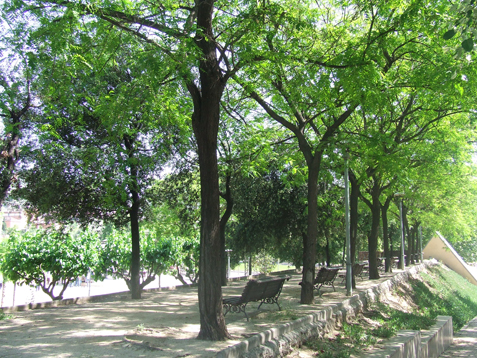
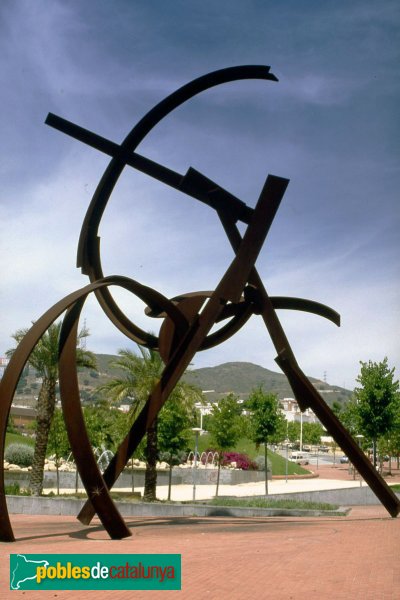
Named Europa Park, this urban space opened in 1992, the year of the Barcelona Olympics. Extending from the Besos River to the hillsides, it consists of more than 59,000 square meters of greenery, walkways, sport zones and playgrounds. It's a place where people stroll, lie on the grass, do a little exercise or sit on a bench while enjoying the quiet that results from having contained the highway that runs through the neighborhood underground, rather than above ground. There are also some interesting sculptures in the park, including Olympia, a jumble of straight and curvilinear iron pieces, by a Swiss artist named Paul Suter.
.
Eventually, you need to head over to the other side of the avenue, where Dr. Ferran Street becomes Puig Castellar Avenue, to begin the uphill walk into the neighborhood below Puig Castellar and the surrounding hills. But this is where I will leave you now and take up again in Part II of my description of this day trip.
.
Hasta entonces amig@s,
.
Carloz

Sunday, February 24, 2008

Spanish Time


The arrival of the new AVE in Barcelona 5 minutes early (or eight minutes, depending on which newspaper one believes) but following after a 2 month construction delay, started me thinking about differences between the sense of time in Spain and the USA. (Before I go on, let me say that to me a two month delay does not seem like much on a construction project of the magnitude of the AVE and I think such a thing could happen anywhere.)
.
Maybe “sense of time” isn't the most accurate phrase. Some foreigners might say a “lack of a sense of time” would be a better way of putting it. I believe it would be more accurate to say that there is simply a difference between the importance attached to time in Anglo-Saxon and Latin cultures. Anyway, here are few personal anecdotes that touch on this difference.
.
When I lived in Madrid, it always tickled me that the clocks on two public buildings across the street from each other had slightly different times. The clocks on the Banco de España (i.e., the Spanish treasury) and the main post office at Plaza de Cibeles displayed times that were two minutes apart. (By the way, the main post office has since moved.)
.
Speaking of the post office, while living in Madrid I received a notification of a certified letter one afternoon, so I promptly went to collect it the next day. Opening it immediately, I found a letter that had been sent 13 days earlier from the immigration office in Madrid requesting additional documents from me. The letter said that I had 12 days from the date on the letter to do this. It was a Friday afternoon, after the immigration office's closing time of 1pm, which meant Monday would be the earliest I could bring the documents – 4 days late! I thought, “Oh, my gosh, I'll have to get proof from the post office that the letter took more than 12 days to reach me!” So, I asked the postal clerk for a receipt. I was told I had to go to another window for that. After waiting in line at the other window, I was told by another clerk that I had been sent to the wrong window. Thankfully, there was no line at the next window and the clerk there gave me a form to complete for my request. After giving her the completed form she told me I could return towards the end of the next week to collect the receipt! I explained the urgency of the situation to her. She pointed to stacks of forms piled up on a table behind her and said sarcastically, “Well, all of these requests are urgent, too, so you'll just have to wait your turn.” I left the form, but meanwhile took my chances with the immigration office on the following Monday morning. When I explained to the immigration office clerk why I had not come in sooner, he said it wasn't a problem at all and accepted the documents.
.
When I first moved to Spain I worked as a coordinator of a program at a school where one of my duties was to buy supplies for the program on a monthly basis. The school had an account with a certain office supply store that I went to during the first week of each month to place our order. No one told me that the store's two locations closed for the month of August, so that first year I found that out when I showed up at the store and read the “closed until September” sign. I remembered it the next year so went to the store on July 31st, where I again found the store closed until September. It turned out that since the 30th and 31st fell on a Monday and Tuesday that year, a decision had been made to close those two days, too. OK, year three I decided to ask the store staff at the beginning of July what their last opening date would be before their August holiday. I was told the store would be open through the 31st. I showed up on the afternoon of July 31st only to find the store closed until September. You see, a decision had been made that year not to re-open after the lunch time siesta! The next year I finally got the hang of it and did the August shopping during the second to last week of July.
.
There is an accounting service down the street from my apartment here in Barcelona that prepares my tax return every year. I discovered it a few years ago when the office taped up several little signs in its store-front window announcing this service – simple signs on white A4 paper obviously printed on an office printer. The signs are still up and read, “We will prepare tax returns until May 30, 2004.”
.
There is a tiny, little office supply store in my neighborhood that, like many businesses, closes for siesta. Occasionally the store doesn't re-open in the afternoon. I asked the owner about this one day and was told that it depends on how busy he is in the morning. If it's a really slow day, he figures there is no reason to open again after lunch.
.
There is a restaurant near my place that advertises lunch served until 4pm. If I show up at at 3:40 or 3:45, sometimes they serve me, but other times say it is too late because the kitchen is closed. I guess it depends on how business has been that day.
.
I have lived here for almost 8 years now, so I think I have pretty much reached a stage of acceptance of things like this. Or maybe its just really good denial.
.
Hasta luego amig@s,
.
Carloz

Wednesday, February 20, 2008

Z promises more English, Rajoy more Spanish


Z is the Spanish Prime Minister, José Luis Rodíguez Zapatero. One of his latest campaign promises is to put 20,000 native English teachers in public schools -- 12,000 part-time teachers and 8,000 English language assistants -- if the Socialist party wins the March 9th general election.
.
Meanwhile, challenger Mariano Rajoy has said that if the Popular Party wins he will pass a law giving parents in Spain the right to have their children enducated in Spanish. This is actually aimed at the Autonomous Region of Catalonia, as public education here is conducted in Catalan. (All other Autonomous Regions where two languages are spoken give parents the option of sending their children to Spanish language or local language schools.)
.
¡Vamos a ver!
.
Carloz
.
P.S.
.
If you want to read more on the Spanish election, the BBC news website today ran a pretty good little overview of it in an article entitled, "Spanish PM Faces Voters' Verdict." I especially liked the following line in the article: "If the US election is a marathon, Spain's is a sprint." Thank God for that!

Monday, December 17, 2007

STOP TIPPING SO MUCH! Spain's Economy Minister says Spanish public doesn't know the value of a euro


At 4.1%, Spain's inflation rate is currently higher than other euro zone countries. Economy Minister Pedro Solbes apparently believes that part of the reason for this is the failure of Spaniards to understand the value of the euro.
.
At an economic forum held on Saturday he said, "We Spaniards haven't internalized the value of a euro, which can be seen in bars and cafes. When people leave tips, they don't take into account that 20 cents is worth 32 pesetas and that one euro is worth 166 pesetas. They often leave a tip that's 50% the value of the product."
.
Before the euro replaced the peseta in 2002, Spaniards were in the habit of leaving 25 peseta tips in cafes, which would have equaled somewhere between 10 and 15 cents.
.
While Solbes added that he believes inflation will return to below 3% before next March, he admitted that he was wrong when he said some years ago that the euro had not had an inflationary effect as a result of merchants rounding up prices at the time of the conversion from the peseta.
.
"When I was in Brussels (as the EU Economic Affairs Commissioner), I said the opposite, but now I can say that the euro has had an inflationary effect on low cost items."
.
So, why should we now believe his predictions about inflation? ¡¿?!

Sunday, December 16, 2007

Interesting results from Spanish surveys, studies, reports, etc.


GUESS WHICH WORLD LEADER SPANIARDS CONSIDER TO BE THE WORST. If you guessed US President George Bush, you were only off by two. Bush came in third to last, behind Cuban leader Fidel Castro in the pentultimate position, leaving Venezuela's President Hugo Chávez to reign as the international leader held in lowest esteem.
.
This terrible trinity of the worst was the result of a poll of 12,000 Spaniards conducted by the Elcano Royal Institute (Real Instituto Elcano), a Spanish think-tank. The survey, which was carried out between November 26th and December 3rd, had Chávez finishing last in the popularity poll with a 1.4 ranking. Next came Castro at 1.9, Bush at 2.2, Nicaragua's Daniel Ortega at 2.9 and Russia's Vladimir Putin rounding out the bottom at 3.4. The most respected leaders were EU foreign policy chief Javier Solana, with a 6.2 rating, followed by former IMF director Rodrigo Rato with 6.1, German Chancellor Angela Merkel with 5.8, and French President Nicolas Sarkozy and UN Secretary-General Ban Ki-moon in a tie at 5.3.
.
MOST SPANIARDS SUPPORT ZAPATERO'S FOREIGN POLICY, according to the same Elcano study. Of the respondents, 54% view the Spanish Prime Minister's foreign policy efforts positively, while 39% take a negative view.
.
CONSUMER PRICE INDEX UP AGAIN according to statistics released on Friday by Spain's National Statistics Institute (NIE). November's CPI was 4.1% compared with 3.6% in October. In addition, the European Central Bank, in its monthly economic bulletin released the day before, noted that inflation has risen in Spain, Portugal and the euro zone in general.
.
SPANIARDS UP TO THEIR NECKS IN DEBT according to a study by The General Association of Consumers (La Asociación General de Consumidores), ASGECO. The Study of Family Indebtedness (Estudio sobre el endeudamiento de las familias) released by the organization last week reported that 40% of Spanish households have difficulty making ends meet each month, only 30% have money left over at the end of the month, and nearly 60% face the possibility of having to obtain a second mortgage on their homes.
.
BARCELONA HAS THE HIGHEST CINEMA TICKET PRICES IN SPAIN AND CORDOBA THE LOWEST according to a comparison done by FACUA.org Consumers in Action (Consumidores en Acción). The survey of movie ticket prices at 104 cinemas in thirty-three cities across Spain found that the price of admission can vary up to 90% nation-wide. Barcelona, A Coruña and Madrid have the most expensive cinemas, against Jaén, Cadiz and Cordoba, the lowest priced. The average price nationally is 5.41 euros. Ticket prices have risen 3.6% over 2006, when the previous study found an average price of 5.22 euros. The average was 5.05 euros in 2005, 4.80 in 2004 and 4.62 in 2003.
.
In the report, FACUA denounced as illegal the practice of prohibiting movie-goers from bringing with them beverages or food from outside cinemas. The association recommends that consumers request a complaint form from cinemas to denounce this irregularity, since it is a violation of the General Law for the Defense of Consumers and Users. (La Ley General para la Defensa de los Consumidores y Usuarios.)
.
TWO OUT OF EVERY TEN RAMBLERS ARE LOCALS according to a study by the Barcelona NGO Friends of The Rambla (Amigos de La Rambla / Amics de La Rambla). Only 2 out of every 10 people who walk along Barcelona's Las Ramblas are Barcelonans, whereas nearly 60% are foreign tourists. Another 20% or so are visitors, too, but from Spain rather than abroad, with about 10% of these from other parts of Cataluña.
.
Of those surveyed, 34% said that Las Ramblas' diversity and cosmopolitanism was what attracted them most; 20% felt there were usually too many people on the famous paseo; 15% indicated that they felt insecure and vulnerable to theives and 5% were there in order to get to La Boqueria public market. The most traveresed section is between Plaza Cataluña and Plaza Real. Most people enter Las Ramblas from Plaza Cataluña, whereas the point of access least frequented is Arc del Teatre street.

Thursday, December 6, 2007

It's another bank holiday in Spain! This one's Constitution Day...


...or el Día de la Constitución Española. That's right, only a few weeks before the Christmas, New Year and Reyes holiday season, Spain has yet another holiday.
.
This is one of the few holidays in Spain with completely secular roots. It commemorates the anniversary of the national referendum held on 6 December 1978, in which 88% of Spanish voters approved the constitution which had been passed by parliament on 31 October of that same year. Although the constitution actually came into effect on 29 December 1978, the date of the referendum was established as a national holiday in 1983. Perhaps this was because it was one of the crowning moments in the period from 1975 to 1978, referred to as The Transition, during which Spain was converted from a fascist dictatorship to a parliamentary monarchy.
.
This year's anniversary is the 29th. I don't know if there are any special plans for 2008's nice round 30th anniversary, but for the even-numbered 25th a special web site was designed that includes an official English translation of the constitution. Click here to read it.
.
For a holiday that marks such a notable event in the country's history, it's not a something the Spanish people seem to celebrate very much. Sure, there are formal events participated in by politicians, royalty and celebrities. But on the street, there is not much that I can see to mark the occassion other than special little flags flying from city buses. (Except, here in Barcelona the little flags are Catalan and not Spanish. Go figure.) For most people, it's just a day off work.
.
Well, perhaps I should say, a "few days" off work, because Constitution Day is followed by another national holiday on 8 December. That one is Immaculate Conception (La Inmaculada Concepción), which, of course, refers to the immaculate conception of the Virgin Mary. This particular representation of Mary was designated the "patron virgin" of Spain in 1760, so it's a holiday with a longer history than Constitution Day. However, from what I can tell, it doesn't seem to have much meaning to most Spaniards either. As a matter of fact, when I ask locals if they know what the holiday is, most say something equivalent to, "I think it's some religious holiday."
.
In other words, "Who cares?! I'm just glad it's a long weekend!"
.
Amen to that.
.
Hasta luego amig@s,
.
Carloz

Saturday, October 20, 2007

Interesting difference in Spain and US newspaper coverage of the same story


There has been a story in the news recently that today I saw mentioned for the first time in an American newspaper. The article, in the International Herald Tribune (IHT), revealed something I have not seen mentioned in Spanish coverage of the same story. Before I say what that was, let me give you a little background.
.
Manel Blat Gonzalez has been fighting to have his name removed from the rolls of the Spanish Roman Catholic Church. It started a few years ago when the archbishop of Valencia refused Mr. Gonzalez' request to add a note to his baptismal record stating that he no longer considered himself Roman Catholic. Next Mr. Gonzalez asked the Agencia Española de Protección de Datos (the Spanish Data Protection Agency) to intervene. The archbishop twice refused the Agency's order that he comply with the request and the Church eventually appealed to the courts. The case ended up in Spain's Audiencia Nacional (National Court), which this week ruled in favor of Mr. Gonzalez and the Agency. The archbishop is considering appealing to Spain's highest court, the Tribunal Supremo.
.
So, what was different about the IHT report? Well, it mentioned that Mr. Gonzalez was gay. That was news to me because his sexual orientation had not been referred to in any of the Spanish articles I had read, including the most recent one in El Pais.
.
Of course, I don't read all of the Spanish papers and I haven't read every Spanish news story about this, so I imagine it probably has been mentioned somewhere. However, I just did a quick Internet search of various Spanish media outlets and did not see his sexual orientation talked about anywhere. This leads me to believe that perhaps the Spanish media doesn't find it a very relevant fact.
.
While I can see why it would be considered newsworthy by the IHT, what with the Roman Catholic Church's position on homosexuality and the Spanish Church's opposition to gays being allowed to marry in Spain, it is still an interesting difference, don't you think?
.
If you're interested in reading the El Pais article, click here for the on-line version. For the IHT article, click here.
.
Chao amig@s,
.
Carloz

Saturday, October 13, 2007

The day after the National Day of Spain / El día despues del Día Nacional de España


Headlines in all of Spain's daily papers today focused on the fact that Prime Mininister José Luis Rodríguez Zapatero was booed by people in the crowd at yesterday's official observance of the Día Nacional de España in Madrid.
.
Since the same thing happens every year, I fail to see how it merits such treatment; and none of the headlines referred to it being a recurrence. Nor did any of the headlines point out that this occurred despite Zapatero and his party leading slightly in the polls. Maybe these additional points were made in articles or editorials, but I didn't notice that in the newspaper I read today -- La Vanguardia. I have to admit, though, that today I basically skimmed it.
.
Regarding the usual absence of leaders from certain regions at the event, according to La Vanguardia this year's official observance saw the highest representation of Autonomous Region heads. The only regions not represented were the Basque Country and Murcia. Why weren't their leaders there? Well, among other sore points, the Basque leader Juan José Ibarretxe wants a referendum on independence in his region and Madrid has nixed that. As for Murcia, it is headed by Ramón Luis Valcárcel, a member of the opposition Popular Party, but I don't know whether he stayed away in protest or for some other reason.
.
Catalonia's leader, José Montilla, was there and apparently made a point of spending time with the King. This followed recent incidents of protesters in Catalonia burning photos of the King. Montilla had previously lamented these acts, describing them as non-productive.
.
By the way, Zapatero and the regional leaders function as prime ministers in their respective governments. However, they are commonly referred to as presidents, which is shorthand for President of the Government. To me prime minister is more accurate, so that's what I usually use.
.
OK, off politics and civics for now.
.
Chao amig@s,
.
Carloz