Showing posts with label Tourism. Show all posts

Friday, June 12, 2020

Spain to allow German tourists to travel to the Balearic Islands without quarantine: 47 flights already scheduled

Bienvenido de nuevo
The Spanish government made it official today: Germans will be the first tourists allowed to try out Spain's famous sun and sand resorts in what is being called the New Normal—or what I call, “Life after the Coronavirus lockdown but not quite after COVID-19.”

The details: When, where, and how

Next week's partial opening of the country's borders is partial in two ways: 1) only for tourists from Germany and 2) only for travel to the Balearic Islands. In addition, these visitors will be exempt from the 14-day quarantine other travelers to Spain must currently undergo.

Specifically, beginning next Monday, June 15, some 10,900 German travelers are expected to begin alighting on the shores of the islands of Mallorca, Ibiza, and Menorca. (Sorry Formentera fans.) There have been 47 flights scheduled thus far—38 to Palma, 8 to Ibiza and 1 to Menorca. The first two flights are planned for Monday, and will arrive in Palma from Frankfurt and Düsseldorf. The third is scheduled on Wednesday, from Düsseldorf to Ibiza. The premiere flight to Menorca is scheduled to run June 27 from Düsseldorf.

Empty beach in Peguera, Mallorca: Marco Verch
Despite all these plans, these flights are actually provisional, since the official government declaration includes this caveat: “Additionally, by resolution of the official responsible for the Ministry of Industry, Commerce and Tourism, and in accordance with the Monitoring Committee referred to in article 4, the annex may be expanded, modified, revised or updated.” (Emphasis mine.)

On arrival at the airports, passengers will have to complete health questionnaires and undergo screening by healthcare workers. Anyone with symptoms, e.g., a fever or cough, will be given a test. If the test is negative, they will have to agree to "telematic monitoring of their symptoms." A Monitoring Committee, made up of at least one representative from Spain's airports operator AENA, the Ministry of Health, the Secretary of State for Tourism, the Ministry of Foreign Affairs, the European Union and relevant bodies in the areas of health and tourism in the Balearic Islands, will meet every two days.

Tourists will also have to stay a minimum of five nights and provide details about where they will be staying.

Other Special Routes Being Considered

Ibizas's sidewalk cafe's await
Other autonomous regions in Spain may soon be allowed to do something similar. Yesterday, Minister of Health  Salvador Illa said that in the coming days he expected to announce comparable agreements with other regional governments. Indeed, negotiations with the Canary Islands are reportedly in advanced stages, although at least one sticking point remains regarding mandatory requirements, since the government of the Canary Islands wants PCR tests carried out on each tourist arriving on the islands, not only those with symptoms. With the autonomous region of Galicia set to leave the state of alarm this coming Monday, it could be another candidate to open an early travel corridor with an EU country—or countries.

These early travel bubbles are consistent with the government's official declaration, which stated, "It is recommended that pilot programs be launched through the establishment of safe tourist corridors, prior to the end of the state of alarm, in order to verify the operation of the model for lifting temporary controls on internal borders and the recovery of freedom of movement.”

What does Brussels say?

Brussels actually wants to move a bit faster on all this, having recently called for the European Union's internal borders to be reopened next Monday. Some states, like Italy, have opened their borders for all citizens of countries in the Schengen area. Others, like Austria, have only done so for some of their neighbors. And a third group, of which Spain is a part, has not yet lifted barricades for anyone—at least it will not have until this exception of the new Germany-Balearic Isles route comes to pass. The European Commission wants to end this inconsistency and do way with all internal border controls in order to allow free movement from June 15 on, as detailed in a report it presented Thursday.

Source: Contando Estrelas Flickr
It seems that the EU’s call to open internal borders next week has increased pressure on Spain to open up faster. According to El País, “EU Commissioner for Home Affairs, Ylva Johansson, insisted on the recommendation that internal borders must 'reopen as soon as possible.' But she added that the main thing is for everyone to open internal borders completely before opening the EU’s external ones to third-country travelers.”

Despite this, the Spanish government insists that its decisions will be made based on health criteria alone and that, regional exceptions aside, the plan remains waiting until July 1 before completely opening borders to the rest of Europe. In fact, Spain continues to prevent full mobility between its own regions. This situation is due to end by June 22, when the Spanish COVID-19 state of alarm expires.

Meanwhile, Brussels seems to have accepted the fact that the opening of borders within the EU will probably not be completed according to its dictates.

“We understand that reopening on Monday for countries that have not yet decided to do so could be complicated, and that some might take an extra week or two,” Johansson also said.

In other words, the New Normal will not arrive throughout the European Union until July—maybe.

Carlos

---------------------------------------------------------------------------------------------------------------------------

Sources: “Los turistas alemanes vuelven a Baleares y sin cuarentena: ya hay 47 vuelos programados a partir del lunes,” Hugo Gutierrez, El País, 12 June 2020 and “EU’s call to open internal borders by June 15 increases pressure on Spain,” Álvaro Sánchez, El País English Edition, 11 June 2020.

Saturday, October 18, 2014

Spain declared best value winter travel destination

Spain's sunny southern coast
The Iberian penninsula offers some of the best travel deals this winter, with the Costa del Sol offering the best bargain but the Algarve not far behind

The UK's Post Office has found that the Costa del Sol in Andalusia, Spain provides the best value for money this winter. The Algarve coast of neighboring Portugal came in third. Bali, Indonesia was sandwiched in between at number two.

In a new Winter Sunshine Report barometer of 18 destinations in Europe and further afield, Post Office Travel Money found the Costa del Sol cheapest for a bargain break.  The cost of eight tourist staples, including a family meal, drinks, suncream and insect repellent, was just £44 ($71 / €55).  Bali (£47 / $76 / €59) just beat out Portugal’s Algarve  (£48 / $77 / €60) for the runner-up bargain spot.

Winter vacationers looking for more guaranteed winter sun in Europe will find great value on Tenerife in Spain's Canary Islands at £58 ($93 / €73) for the eight items and Ayia Napa in Cyprus at £60 ($96 / €76).  According to the Post Office, local prices in the four eurozone destinations above are either level with last year or slightly cheaper. 

Sunday, October 5, 2014

Jesus x 2; Catalonia, Scotland, Spain, UK; Queen Letizia Goes to School in New York; Madrid's Cruel Bus Shelters; Paragliding in Arcones


Excerpts from and links to my latest Newsvine articles and posts relating to Spain:


Article Photo

Miracle? Spain's monkey image of Jesus appears on a cake in Japan


Jesus appears to have forgiven the Spanish woman who botched his face in what was 'probably the worst art restoration project of all time.'  Yes, the Lord seems to have chosen to use the infamous monkey-like image of Himself to evangelize by appearing on a popular Japanese  …


Wednesday, September 17, 2014

Lugo most economical tourist destination in Spain, Barcelona most expensive

Lugo, Spain
Barcelona is the most popular tourist destination in Spain. And in this case, high demand means high cost.

Meanwhile, lovely Lugo not only offers a UNESCO World Heritage Site, but the best deal for travelers on average.

According to various media reports, TripAdvisor.com has determined that the Catalan city of Barcelona is Spain's most expensive city for visitors, while Lugo in Galica is the most economical place for travelers.

The travel website compared costs in 52 locations around the country and found the average cost of a one-night stay in a four-star hotel, cocktails for two, a two-course dinner with a bottle of house wine and round-trip taxi fare was highest in Barcelona. The price for that in BCN came to €229.11 ($296.35 / £182.70).

The second most expensive spot was Ibiza at €221.43 ($287.13 / £176.33), followed by Palma, Mallorca at €217.97 ($282.46 / £173.58), Palma de Mallorca €218.27 ($282.96 / £173.83), San Sebastian €211.72 ($274.36 / £168.81) and the capital Madrid €183.65 ($238.01 / £146.26).

At the other end of the scale was Lugo, in Northwestern Spain – the only city in the world completely surrounded by intact Roman walls. A four star hotel and night on the town in this historic tourist spot totaled only €115.73 ($150 / £93.20). 

Murcia offered the second best deal in Spain at €116.52. (151.02 / £92.79). Next up were Ourense at €116.68 ($151.22 / £92.93), Badajoz at €119.82  ($155.29 / £95.43) and Castellon at €124.41 ($161.28 / £99.08).

A night in a four-star hotel Barcelona hotel (€145 / $187.93 / £115.47) costs about as much as a night in a similar hotel in Tarragona, along with drinks, meal and taxi (€143.73 / $186.26 / £114.46). Tarragona is a beautiful beach-side port-city in Catalonia with a rich history, including incredible remains of a Roman amphitheater, forum and circus. It is also home to the impressive National Archaeological Museum of Tarragona.

Tuesday, May 28, 2013

Exploring Spain’s Mediterranean Coastline

For those who are unfamiliar with Spain, outside of the occasional trip to one of the touristic hotspots like the Costa del Sol, you may actually be surprised and amazed at the cultural delights and magnificent natural landscapes that can be found around this vast and beautiful country. From the lush green forests of Galicia and Asturias to the breathtaking oasis of Ruidera, there are and endless amount of places to explore, with each new location offering you something new.

Spain’s Mediterranean coastline stretches for an amazing 1660km and a trip along it will offer you more adventure and captivating sights than you ever imagined. If you like to travel in style and comfort, and have your trip laid out for you, perhaps one of the best ways to explore the southern coastline is on a Spanish cruise holiday as this will afford you all of the luxury as well as the sights and sounds of Spain. Some of the best attractions along the southern coast are actually the old ports such as the magnificent harbor at the old Roman city of Cartagena, and you will get to get the full experience as you sail into the port and dock up. 

It is also possible to travel along much of the coast by train: from Barcelona (or you could start in Perpignan, located in French Catalunya) to Valencia to Malaga. RENFE is Spain's national train service. If you want to travel to Gibraltar from Malaga, you can buy a commuter train ticket as far south as Fuengirola, then you will have to either take a bus to La Linea, which is the town on the Spanish side of the border, or you can rent a car and drive into Gibraltar. A taxi from Fuengirola to Gibraltar is also a possibility, which would take about 1 hour, 15 minutes. At the time of this writing, the fare would be about 80 euros. 

If you prefer to tackle the vast expanse of coastline by car, you are likely to be in for a whole different experience, including some rather hot and sweaty days spent in the car in summer, unless you have air-conditioning! Taking the road option does give you much more flexibility on your destinations and timing, and it also allows you to fully explore the real hidden gems of southern Spain. Here are some of the finest locations to visit along the coast, starting from Andalucía in the west and ending up in the dramatic coastline of northern Catalunya.


Malaga is an ideal start point if you are taking a road trip as it is easy to fly into and there are lots of places to find cheap car hire. If you want to get the ‘traditional’ Spanish holiday experience, you could head to the touristic beaches of the Costa del Sol to soak in some rays and indulge in some sangria. Heading east from here, you can discover the ‘pueblo blancos’ which are the white villages of Axarquia. There are lots of quaint little Spanish villages in the region which are all made up of immaculately painted white buildings. Salobrena is a particularly interesting location as it is home to an Arab castle from the 10th Century, which sits overlooking the sea. As you head further east from here, you will enter the much forgotten about region of Almeria, which is home to some spectacular sights such as the Cabo de Gata, and the only recognized dessert in Western Europe, Desierto de Tabernas.


Murcia is a relatively small, but very interesting region of the coastline, which is home to the aforementioned historic port of Cartagena as well as some beautiful beaches and even a set of hot springs. The seaside town of Mazaron is a great place to stop off if you are looking for some comfort and time to relax on the beach, and from here you can head on up the coast towards the famous Levante Español which is where some of the most popular seaside resorts (Benidorm, Torreveija, Gandia) in Spain are situated. If these locations do not take your fancy, there are plenty of great alternative destinations to visit, including the 21,000 hectare freshwater lagoon at Albufera de Valencia. This is a wildlife haven that is home to huge numbers of birds and fish, and is a great place to stop off and relax.


To the north of Levante is the Spanish ‘Golden Coast’ which is called Costa Duarada, and although the beaches in this region are extremely busy during the summer months, there are some great places to visit inland a little way including the spectacular national parks of Poblet and Sierra del Montsant, and the largest wetland region in Europe, the Ebro Delta. There are also some lovely little villages and towns in these regions which have not been invaded by mass tourism, but instead go about life upholding many of the old traditions.
Just 90Km further north is one of the most fascinating places in the whole of Europe, Barcelona. If you really want to get the full Barcelona experience, you should put by at least four days to spend in this magnificent city as there is just so much to discover. Although it is a huge and vibrant city, popular with tourists from all over the world, there are still some untouched seaside locations just a stone’s throw from the main city. Tamariu, Llafranc, and Calella are some worth investigating.

By Melissa Hathaway (mostly) and Carloz (a very little)

Monday, May 20, 2013

Yo Quiero = I Do: A Look at Marriage in Spain Today


Marriage in Spain is a pretty popular state. Indeed, over half of all Spanish adults are married. However, marriage rates have been falling since the financial crisis began in 2008. The year before saw the country's marriages dip below 200,000 for the first time in ages -- to 199,660 marriages to be exact -- and the rate has been falling ever since. The most recent statistics available are from 2011, during which 158,220 Spaniards married.

Wedding Costs

Weddings in Spain have traditionally been huge affairs, with massive parties held after the ceremony to allow all the friends and family of the happy couple to celebrate their big day. In this time of recession even wedding budgets are facing cutbacks though, and last year the average amount spent on the whole wedding fell by 8.3% to €13,190. There is a lot of variation between the most and least expensive weddings, with Madrid weddings costing most, and those in the Canary Islands being among the least costly. The areas where most savings are being made tend to be honeymoons and receptions, with many couples choosing not to take an expensive holiday after their wedding. Today, with recession hitting Spain hard and unemployment rates soaring to over 27%, it’s unsurprising that wedding budgets are feeling the pinch. Another possible result of the financial hardship in Spain at the moment is that the average age for women to marry for the first time has risen from around 25 years in 1991 to nearly 30 in 2008.

Wedding Tourism

Spain is also a popular destination for overseas weddings, its beautiful scenery and historic cities attracting many couples from all over Europe and the rest of the world. Many people come to Spain to marry for the sake of the traditions and customs as much as the location and weather. There are numerous overseas wedding companies who can arrange weddings tailor-made to a couple’s needs, as well as guiding them through the red tape and legal documentation. The requirements vary depending on whether a Catholic or civil ceremony is held; for a civil ceremony the requirements can be complex, and two years residency is needed. Most overseas couples opt for a Catholic wedding, or have a civil wedding in their home country and receive a blessing in Spain. Marrying abroad is often less expensive than marrying at home and couples can combine the costs of honeymoon and wedding. Special wedding insurances are available to protect the couple from disaster and are probably necessary in addition to travel insurance, which is unlikely to cover costs such as wedding dress replacement.

Same Sex Marriage
 
Spain legalised same-sex marriage in 2005, the third country in the world to do-so. The first same-sex couple to marry in Spain, Emilio Menendez and Carlos Baturin German, tied the knot just outside Madrid on July 11th 2005. In the first year of legality approximately 4500 couples married. There was some conflict at the time of legalisation, many Roman Catholics particularly disapproved of non-heterosexual unions, and the Pope called them ‘unnatural, immoral and harmful’; however the law was supported by around two thirds of the population, despite 80% of Spaniards identifying themselves as Catholic. Since 2005 there have been some legal challenges to the legalisation of same-sex marriage, notably in 2007 when the Spanish Family Forum attempted to formally define marriage as the union of a man and a woman; the motion was rejected by the Spanish Congress. Today gay couples come from all over the world to marry in Spain.

Wedding traditions

Spanish wedding traditions include the groom being escorted by his mother up the aisle, where he waits for his bride, who will be led by her father. After the vows the groom traditionally gives his bride thirteen coins in a purse; to represent a dowry and symbolise his intention to provide for her. The bride gives her unmarried female guests small pins in the shape of flowers; these are worn upside down and if they become dislodged and fall out during the reception it is said that the wearer will soon be married.

Divorce laws

Divorce was only legalised in Spain in 1981, over a century after the UK. Since then divorce laws have been reformed to rid them of the notion of a ‘guilty party’ in the marriage. Divorce rates have grown since legalisationin 2002 around 15% of Spanish marriages ended in divorce, higher than Italy but much lower than the UK, where the figure was 42.6%. Divorce rates seem to be stabilising now, possibly due to the recession making divorce too expensive for some couples. Rates of marriage have fallen sharply over the same period; halving between 1970 and 2011. This trend is mirrored throughout Europe, with similar falls in the UK. Many more Spanish couples now are choosing to live together, rather than marry, which is borne out by the numbers of babies born out of wedlock, which have soared from under 2% in 1970 to around a third of live-births in 2011. The stigma historically attached to babies born to unmarried mothers has lessened materially.

So, who knows -- once the economy straightens out, there may be quite a boom in marriage ceremonies, as couples who put off 'making it legal' for financial reasons decide to formally tie the knot.

By Melissa Hathaway (mostly) and Carloz (very little)

Saturday, April 13, 2013

Barcelona loves, loves, loves tourists - especially when times are hard!

Barcelona's El Periodico newspaper is reporting that in a recent survey of the city's residents, positive views of tourism are sky high, with  97% of locals seeing tourism as beneficial, 96% believing it brings in a great deal of money and 60% selecting it as the industry that most enriches the city.

This overwhelmingly positive view is more than understandable as the city continues to suffer from recession. Barcelona's position among international travelers has allowed the tourism sector to withstand the effects of Spain's economic crisis. In 2012 the city ranked fourth among European destinations in length of hotel stays, just behind London, Paris and Rome.

With tourism increasing 0.7% last year (7.44 million visitors in total), local people are apparently grateful that the sector's numbers continue to grow, even in these hard times. According to the newspaper, five years ago the view of tourism among Barcelonans was 16 points lower.

In an editorial, the paper concluded, "Barcelonans have rewarded the effort to shape tourism that is  balanced between their needs and those of the foreigners who visit and stay overnight in the Catalan capital. So finds a study published by the City Council which showed that among city residents there has been an increase in the view that tourism has a positive impact on their lives. Thus, the study discounts  those old local negative perceptions of the steadily increasing presence of tourists."

The city councilor responsible for tourism, Sonia Recasens, told El Periodico that the actual reason the perception of tourism has improved is due to the city government's efforts to soften the impact of such  large numbers of visitors on the city's citizens. She cited as examples the rearranging of parking spaces for the large numbers of tour buses around La Sagrada Familia and making the city center safer.

Meanwhile, President of Tourism Barcelona, ​​Joan Gaspart, simply said that tourism is a valuable asset to the city. He projected that the local government will benefit from a 34% take of the estimated 50 to 60 million euros that will be collected next year from the Catalan Region's tourist tax of up to 2.50€ per person per night, which started being added to hotel bills last November. He said that, among other things, this money will be used to better promote the city as a tourist destination.

Related post: Where do most tourists in Barcelona come from?

Where do most tourists in Barcelona come from?


Answer: the United States of America. In fact, the year 2012 consolidated the U.S.A. as a major client of Barcelona's tourist industry. Last year American tourists totaled 635,000, or 8.5% of all travelers.

The large number of  U.S. travelers has been attributed to the rise in the number of cruise ships docking in the city, with many Americans choosing to embark here, as well as more direct flights and promotional campaigns.
 
After the Americans came the British, the group that had the most significant growth (a 12% increase), while at third, fourth and fifth were the French, Italian and German. There was a dramatic increases from residents of Eastern European countries (Czech Republic, Russia and Poland), which jumped nearly 32% in one year, while visits from the rest of the world grew by a healthy 17.6%.

That last number resulted from visitors who came from many developing countries. Looking beyond the quantity of travelers to the qualitative effect of this group, credit card spending by Russians grew by a dramatic 55.7% last year, for a total of 146.7 million euros. Among Chinese tourists this spending leaped by 71.4%.

When it comes to Americans, there is the added bonus that this market is reportedly one of the most profitable for the city, in terms of the average amount of money they spend daily.

In 2012 the tourism sector rose 0.7% overall, with 7.44 million people visiting Barcelona, of which the majority were international visitors and 21.8% were from other parts of Spain. Visits by Spaniards decreased last year by 6.8%. 

Barcelona's position among international travelers has allowed the tourism industry to withstand the effects of Spain's economic crisis. In 2012 the city ranked fourth among European destinations in length of hotel stays, after London, Paris and Rome respectively.

Related post: Barcelona loves, loves, loves tourists - especially when times are hard!
 

Sunday, May 1, 2011

Just in time for summer, Barcelona bans bikini wearers, shirtless men and nudists from its streets

Make sure to wear a shirt if you want to walk around in the stifling heat of Barcelona this summer, or you may pay dearly for it -- up to 300 euros!

Just in time for the tourist rush, the Spanish city known for its beaches and relaxed lifestyle has prohibited not only public nudity, but also the wearing of bathing suits away from swimming areas.

Beset by the hotelier and merchant lobby, who have protested for years that tourists walking around town with exposed torsos give Barcelona a bad image, the city council on Friday approved new legislation to prohibit and punish those who go down the street naked, bare-chested or in a bikini. The measure, which goes into effect next month, was approved just four weeks before municipal elections.

How the law will work

Complete nudity will only be allowed on Barcelona's officially recognized nude beach, Mar Bella, which is the only one in the city that has sand dunes, making it a somewhat secluded spot. Going shirtless or wearing swim-suits will be allowed only at pools, beaches and surrounding areas, such as the Paseo Maritimo stretching along the Mediterranean. Doing so anywhere else in the  city, including while strolling along the emblematic Las Ramblas boulevard or having refreshments at a sidewalk cafe, could result in a fine larger than the 200 euros one has to pay for running a red light: between 300 and 500 euros for going naked, and 120 to 300 for not wearing a shirt. In practice, local police will not fine transgressors immediately: nudes and semi-nudes alike will first receive a warning and an invitation to cover up. Fines will only be given to those who refuse to cooperate or who are caught again for the same violation.

Barcelona's police officers will probably easily recognize nudity when they see it, but how will they determine semi-nudity and its appropriateness? What is the difference between a woman wearing a bikini bathing suit and one wearing a pair of skimpy shorts with a bikini halter top? How far can a shirtless guy walk from the beach before being considered indecent? What happens if while a police officer is fining a bikini-wearing, shirtless couple who wander into a neighborhood near a beach, a sweaty construction worker without a shirt carries a heavy object out of building-site onto the street?

Barcelona on the cutting edge

While at least two other Spanish municipalities have passed legislation banning nudity, none have gone so far as to outlaw semi-nudity. In 2008 Alicante established fines ranging from 751 to 1500 euros for pubic nudity. The city of Las Palmas published an edict in 2004 stating that "nudity, when practiced in places of public transit, practiced en masse, or improperly, is no longer natural and becomes exhibitionism forced on others." Since there was apparently no fine or other punishment prescribed, I'm not sure how nude-free Las Palmas is today. But Barcelona's streets may soon be free of bikinis, swimming trunks and a few tourists.

Maybe next the city council will spend some time and money cracking down on another worrisome group of people who tend to freely wander Barcelona's streets, as well as its beaches: pick-pockets and purse-snatchers.

Cross posted on Newsvine.

Sources:
El destape urbano, non grato (Urban nudity, non grata) - La Razón (with video report)
No es un biquini, es un 'top' (It's not a bikini, it's a 'top') - El País

Sunday, May 4, 2008

Barcelona's April Fair - Feria de Abril


Today is the last day of the 37th edition of Barcelona's April Fair. Some of you may be thinking, “Why does a so-called April fair happen in May?” – and those of you who know Spain may be asking, “Isn't the April Fair held in Seville each year?”
.
Well, the original April Fair, which was first held in 1847, is the one that occurs in Seville each year. It usually starts two weeks after Semana Santa (Holy Week). There are also smaller April Fairs held in several Andalusian cities and towns at around the same time.
.
In 1971 immigrants to Barcelona from Andalusia, and their descendants, began their own version of this rite of spring. Today Barcelona's is the second largest April Fair in Spain, rivaled only by the one in Seville. This fair typically runs from the last week of April through the first week of May.
.
So, just what is an April Fair? Well, first and foremost, it is fun. Secondly, it's an opportunity to revel in Spanish, especially Andalusian, culture – flamenco, sevillianas, rumbas, boleros, pienetas, mantillas, shawls, riding jackets, castanets, cantaores, bailaoras, Jerez sherry, manzanilla wine, tapas, gazpacho, ham, and, my favorite, the Spanish confection churrrrrrrrros!
.
In Barcelona's version, the April Fair is also a celebration of multiculturalism. This is in recognition of the fact that Catalonia absorbed hundreds of thousands of “internal immigrants”from Andalusia, Murcia and Extremadura during the 50s, 60s and 70s and is now absorbing a new wave of immigrants, but this time from Latin America, Morocco, Pakistan and Eastern Europe. Indeed the current President of the Catalan government, José Montilla, was one of these “immigrants” from Andalusia, having relocated with his family to Catalonia when he was 16.
.
Because of all this, aside from the typical pavilions (casetas) dedicated to towns in Andalusia, you can find others like the Casita Latina, the Centro Cultural Gitano La Mina (The Gypsy Cultural Center of La Mina) and the Moroccan pavilion, with food, drink and gifts on sale in support of El Colectivo para la Defensa y la Protección de las Constantes Sagradas del Reino de Marruecos (The Collective for the Defense and Protection of the Sacred Attributes of the Kingdom of Morocco). In addition, visitors to the festival are a mosaic of people from around Spain and the world. However, there are usually not very many tourists. For that last reason, I find it a particularly authentic experience.
.
Another difference between the events in Seville and Barcelona is that in Seville the pavilions are privately owned and one must be an insider of sorts (e.g., a family member or friend, a member of an organization or willing to pay a lot of money) to gain entry. While in Seville members of the public can walk around and “press ones nose to the glass,” metaphorically speaking, at Barcelona's more egalitarian event anyone can walk into a pavilion, sit down and, if they dare, dance! In Seville, the pavilions are decorated, but tend to all look similar from the outside. In Barcelona pavilion interiors and facades are colorfully, often cleverly, decorated -- and in Barcelona, there is a even a contest for best decor!
.
Each year the sponsoring organization, FECAC (Federación de Entidades Culturales Andaluzas en Cataluña = Federation of Andalusian Cultural Groups in Catalonia), chooses the top three pavilions, as well as the best interior and best facade. This year there were 58 pavilions and the prizes went to:

All the pavilions of Barcelona's Feria de Abril are welcoming places where members of the public can rest from walking around the fairgrounds, buy a drink, eat a meal, snack on tapas, listen to music, watch dancers, or get up and dance. Most of the pavilions are sponsored by cultural associations created by and for Andalusian immigrants and their descendants. There are also pavilions sponsored by political parties from just about the entire spectrum. In addition to pavilions, there are stalls selling clothing, arts, crafts, and food items from around Spain. There is also a fun-fair for kids, with a Ferris wheel and other rides, as well as little stands selling hot dogs, ice-cream, cotton candy, drinks and, of course, churrrrrrrrros!
.
Admission to the fairgrounds is free. Prices in the pavilions are regulated by the fair organizers, but prices in the stands and stalls are not. So, the best deals are on food and drink often in the pavilions.
.
The entire thing is an 11 day feast of sight, sound, smell, touch and taste. And the joy is contagious – whether its that of the professional dancers on the stages, the colorfully costumed bands of singers & dancers who roam around the grounds or the civilians strutting their stuff on the pavilion dance floors.
.
¡Viva la feria de abril!
.
Carloz
.
P.D. Y, ¡viva los churrrrrrrrros!

Sunday, March 16, 2008

A Holy Week Confession / Una Confesión de Semana Santa


What's the confession? Simply that I find Spain's Semana Santa observances really boring.
.
Well, having the week off I find interesting, but the Semana Santa celebrations held throughout Spain are sooooooooooo boring. The first time I saw one of the traditional processions, I initially found the phenomenon rather interesting. After the first hour or so, however, my mind started wandering -- and wondering what the big deal was about. I ended up feeling like I was at a slow motion, humorless Mardi Gras parade on downers.
.
Despite the history, the color, the pageantry, the crowds, and the obvious effort put into the events by the organizing groups (called brotherhoods and fraternities / hermandades y cofradías), these are simply people traipsing about in somewhat frightening looking “penitential robes” (think KKK), carrying enormous religious tableaus (similar to those that can be seen in many Roman Catholic churches) and marching methodically to mind-numbing dirges. You almost expect to see self-flagellating footsloggers somwhere in all the fanfare. What fun!
.
Maybe "ominously boring" would be a good way of describing such depressing extravaganzas. To me it's sort of like a bad dream that keeps repeating -- here comes another group of hooded men laboring under another massive platform that holds another brightly painted Sacred Heart / Virgin Mary / Crucifixion / Martyred Saint sculpture, followed by another group of robed acolytes, followed by another group of candle-carrying women in black, followed by another group of hooded men laboring under another massive platform that holds another brightly painted Sacred Heart / Virgin Mary / Crucifixion / Martyred Saint sculpture, followed by another group of robed acolytes, followed by another group of candle-carrying women in black, followed by another group of hooded men... All to the accompaniment of incessant drumming, mournful wailing, and/or brass instruments slowly blaring funereal hymns.
.
I find Barcelona a good place to spend this holiday week because there are not very many Semana Santa spectacles, and, therefore they are easy to avoid. In many other cities, especially in Andalusia, they seem to almost completely take over the streets. I speak from some experience, because despite my negative reaction to that first Semana Santa scene, I have given it a try in various Spanish cities, including Alicante, Granada, Malaga and Palma de Majorca.
.
Being in Palma was similar to being in Barcelona (i.e., no problems skipping the realtively few parades), so I enjoyed every bit of my time there. While I loved the cities of Alicante and Malaga, I did so despite visiting during Semana Santa. Alicante didn't have as many parades as Malaga and in both places I could at least head to the beach for a little respite when there were "festivities" droning on. In landlocked Granada, however, I was more or less trapped. Indeed, I remember feeling almost hounded by the city's seemingly non-stop processions!
.
Instead of the memory of that experience fading, it has actually expanded to include fantastic images of myself being pursued by penitents down Granada's ancient streets, which in my mind seem to wind around in an Escher-like labyrinth. I try to get away from them and turn one corner after another only to keep stumbling upon more giant icons looming above throngs of mesmerized people wearing tunics, hoods and masks. As I am pushed and shoved around I sense that the participants are all trying to absorb me into the crowd so that I will be converted into one of the hordes of zombies condemned to an eternity of watching the monotonous marches go...by...so...very...very...slowly.
.
(George A. Romero could have a field day with this “false memory” of mine – not to mention Freud!)
.
So, having experienced traditional Semana Santa events in the past, when this time of year rolls around I flatly refuse to go to places like Seville and Cadiz, which are supposed to have some of the "best" celebrations. No, I prefer to be on a beach somewhere in Catalonia.
.
Hasta siempre amig@s,
.
Carloz

Sunday, January 20, 2008

The Guggenheim Museum Bilbao


If you haven't been yet, go! If you have, then you know why I say this.
.
The Guggenheim Museum Bilbao provided me with one of the best museum experiences I have ever had -- and art museums are not my favorite types of museums. I usually prefer history museums. However, this art museum is fascinating on so many different levels, that I think it would appeal to almost everyone. Words like light, joy, curiosity, wonder, fun, dynamic, fresh, imagination, inspiration, relaxation, meditation and activity come to mind when remembering the full day I spent there. Indeed, I arrived just after the 10am opening and stayed until it closed at 8pm.
.
Of course, the museum building and the site itself are a true wonder of a work of art. It is well worth taking the time to use the audio guide provided for a tour of the grounds and interior of the "titanium icon," which both echos and compliments the Guggenheim Museum building in New York City. Nestled between Bilbao's Nervión River and its Moyúa neighborhood, the limestone, glass and titanium structure billows out like a series of giant sails caught in the wind.
.
On the riverside is a curving walkway that winds around fountains and works of art, such as Louise Bourgeois' Maman (French for "Mama"), a giant spider cast from of bronze, stainless steel and marble. Just past Maman, the building stretches beneath the modern Puente de la Salve bridge that spans the river. Then the museum shoots up a limestone tower-like facade on the opposite side of the bridge. To commemorate the 10th anniversary of the Bilbao Guggenheim, a Red Arch designed by Daniel Buren was added to the bridge in 2007. It is well worth the walk up the stairs set into the tower to see the views of the museum, the bridge, the river and the city.
.
On the side of the building facing Iparraguire Street, visitors are welcomed to the museum's entry plaza by another artistic beast: Jeff Koons' 40 meter tall Puppy, a giant flower sculpture constructed of a steel frame covered by 6500 kilos of earth and 40,000 plants. (On a stroll around the museum area a few nights later, I saw a frisky little cat playing with some of the flowers at Puppy's base.)
.
Inside the building there is a bright reception area with friendly people prepared to greet visitors in English, Spanish or Basque -- and probably a few other languages, as well. After paying the 10.50 euro entrance fee, a hand-held audio guide device is provided, with a choice of several languages.
.
The next room is the atrium, which is warm and welcoming, despite it's size. Measuring 650 square meters, it rises 50 meters to the skylight above, and has a glass curtain looking out towards the river on one side. On the other sides it is encased in limestone and includes a couple of glass elevators and an open air stairwell. (For those who don't like heights, there are also an enclosed stairwell and an enclosed elevator.)
.
On the day I visited, we were greeted by Juan Pérez Agirregoikoa's large cream colored fabric panel dangling down from the floor above, with the following question painted on it in red and black letters: "¿Habeis cedido a vuestro deseo?" ("Have you all given into your desires?)
.
Just outside the atrium is a large terrace, covered by a limestone canopy supported by a central column. The terrace looks over a shallow pond installed next to the river. The terrace holds Jeff Koons' Tulips, while the pond sports two water-art-works: Fire Fountain by Yves Klein and Fog Sculpture # 08025 by Fujiko Nakaya.
.
Back inside the building, the exhibition spaces extend out and up from the atrium. There were two exhibitions when I was there:
  • Art in the USA: 300 Years of Innovation, which surveyed the history of the country's visual arts through approximately 200 works of art filling the galleries on the first and second floors floors of the building, and

  • Chacun à son goût (Each to their own taste), a selection of works by 12 artists who were Basque by either origin or residency. These were displayed in the exhibition spaces on the third floor.
I enjoyed both exhibitions -- almost as much as the building itself! Art in the USA will run until April 27, 2008; Chacun à son goût until February 3, 2008.
.
Chao amig@s,
.
P.S. The Guggenheim Bilbao web site offers a great virtual tour.

Tuesday, January 1, 2008

New Year's Day in Getxo


I haven't got much time, but I wanted to post something on the first day of 2008. So, I'll write a little about the place where I spent this cool, sunny day.
.
Getxo is a beach town within the greater metropolitan area of Bilbao. It is located at the mouth of the Nervion river, just inland from the Bay of Biscay. It offers great views of the bay, especially towards the north.
.
One such area is La Galea, which is where this post's photo was taken. This cliff top spot has a little park next to the abandoned fort and lighthouse that give the place its name. Aside from a sign reading "La Fortaleza La Galea" (Galea Fort), there was no other information posted about the fort, but it seemed to me to be at least a couple of hundred years old. It's a great spot for picnicking -- and I say that from experience.
.
Other sites I enjoyed in Getxo included several stunning 19th century mansions, some lovely parks, a series of relaxing water-side walkways, a hill-side elevator that provides a nice view of the river and bay, and the 1893 "transporter bridge". This contraption is also known as a "ferry bridge," because it is sort of a combination of the two, that carries cars across the river in a gondola. What a great ride!
.
Hasta luego amig@s,
.
Carloz

Wednesday, August 15, 2007

From the seaside to the hillside - Part 3 (Vallvidrera)

In my opinion, Vallvidrera, which is perched on the crest of the Collserola hills above Barcelona, is one of the city's loveliest neighborhoods. To get there, I usually take the FGC from Plaza Cataluña. (FGC stands for Ferrocarrils de la Generalitat de Catalunya, which is the name of the Catalonian government railway system. Within the city, FGC trains run underground, but outside the city they climb out into the light. Barcelona's transportation system is completely integrated as far as fares and tickets go. So, a pass for the metro is also a pass for the FGC.)
.
Directly in front of Café Zurich are two entrances to the underground Metro and FGC stations. From either of these two entrances one can enter the FGC station. To get to Vallvidrera take any FGC train except the one to Av. Tibidabo. There are television screens throughout the station indicating when and from which track the next train leaves. Since there are trains leaving every few minutes, it's usually possible to hop on a train immediately. I've never had to wait more than about 5 minutes.
.
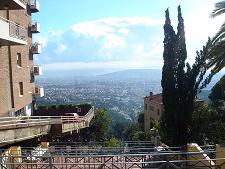
After a short ride, it is necessary to get off the train at the Peu del Funicular station and transfer to the modern little funicular that goes up to Vallvidrera. This funicular station is located in an area known as Lower Vallvidrera (Vallvidrera Inferior). The transfer is easy and fast at this little open-air station; and the ride up the hill, in metal and glass cable cars manufactured in Switzerland, offers some excellent views of the city and sea below. The best views are from the seats in the back of the car.
.
The funicular's hours are 4:30am to 12:15am weekdays and 5:30am to 12:45am weekends and public holidays. Cars run every 6 minutes on weekdays and every 10 to 15 minutes on weekends and public holidays.
.
Although one wouldn't know it from the sleekly contemporary appearance of the Peu de Funicular station and cable cars, this line has been in operation since 1906, when the rail line was extended from Sarrià to Lower Vallvidrera. It wasn't until 1998 that the funicular was converted into the totally automated system it is today.
.
There is only one stop between Lower and Upper Vallvidrera: the tiny Carretera de las Aguas (Water Road) station. At this stop it is common to see hikers and bicyclers getting out. However, I usually prefer to ride to the top and then walk down to the Carretera.
.
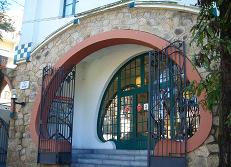
Next comes Upper Vallvidrera and a fantastic remnant of the 1906 line -- the modernist art nouveau Vallvidrera Superior station. Walking around this little jewel of a station, with its voluptuously curved windows and entrance, is like stepping back in time to the era of Gaudi. Constructed in 1905, the station was designed by the architect Bonaventura Conill i Montobbio, who who designed a good number of the buildings in Vallvidrera. Make sure to visit the viewing platform at the back of the station's lobby.
.
From here it is possible to take a city minibus (line 111) to the top of Mount Tibidabo, where a large church sits on top of an amusement park overlooking the city. Since Vallvidrera is actually surrounded by the protected Collserola Natural Park, it is also a great place to start off for a hike in the woody hills. Before doing anything else, however, get to know this quaint little neighborhood a bit.
.
The earliest known reference to Vallvidrera appeared in 987, in a document referring to the church of Santa Maria de Vallvidrera and a Gothic style church by that name was built between 1540 and 1587, and is located in what today is the park of Collserola. In the 14th century the "parish" became a "civil jurisdiction." In 1892, what was then the town of Vallvidrera was annexed by the town of Sarrià, which was then annexed by Barcelona in 1921.
.
Despite this long history, major urban development didn't begin in Vallvidrera until the second half of the 19th century, when the characteristics of the area a¡changed from that of a village to a location for summer homes of the increasingly prosperous citizens of Barcelona. A "modern" road was not built to link it with the city until 1888, when the Vallvidrera to Tibidabo roadway was constructed. In 1901 a tram was inaugurated to link Barcelona, Tibidabo and Vallvidrera. In 1906 the funicular connected the area with Sarria. At this time Vallvidrera became a popular summer residence for wealthy Barcelonans. Today it is a handsome residential neighborhood with the characteristics of a small, prosperous town.
.
Directly across from the funicular station is Plaza Pep Ventura. Walking around the little square and the streets surrounding it, one is surrounded by superb views. Walk to one side of the plaza and gaze over the tiled roofs of lovely little houses out onto the green valley below and the Montserrat massif looming in the west. Most of the houses date to the early 1900s, as can be observed by the years inscriptions on the gables. (One house even has a Catalan poem inscribed on it!)
.
Head to the the east along C/ de Queralt, which changes from a street to a series of pedestrian steps. Look between the houses to the left for some great vies of the city. At the foot of the steps you will find the main square of the neighborhood, Plaza de Vallvidrera. Stop in at for a coffee and a sandwich at Bar Josean, which has a back sitting room with an incredible view of Barcelona and the Mediterranean. Nearby, the Can Trampa restaurant doesn't offer much of a view but is a good little spot for lunch or dinner. The plaza also hosts a modernist style wine and cheese shop, as well as a bread shop and a convenience store. One block to the north is the Mercado del Vallvidrera at C/ dels Reis Catolics 2, which sadly is set to close.
.
Walk back to Pl. Pep Ventura along C/ de les Alberes for more fantastic views of the valley leading to Montserrat. Once back at the Plaza, walk up the "street" stairs of C/ dels Algarves. More lovely houses, this time a mix of old and new, will lead you to the Hotel Vallvidrera, dating from the 1900s. Today it is a well maintained senior citizens' residence. It is easy to imagine what the place must have looked lime in its heyday.
.
At this point C/ dels Algarves rejoins C/ de les Alberes. Continue east along Alberes a bit and on the right you will find a steep "stair street" called Escales del Font del Mont carved into the side of the hill. This is one of the ways to reach the Carretera de la Aguas (Water Road) below. At the bottom of the stairs take a right on Torrent de la font del Mont and walk down until it ends at the Carretera de las Aguas. Once you reach this gravel road, head to the left and walk for about 10 minutes to find yourself in a peaceful wooded area overlooking the panorama of the city and the sea. Breathe in the fresh air, have a seat on one of the benches built alongside the road, walk through the trees above the road -- in other words, relax.
.
When you are ready to return to the buzz of the city below, head back in the direction you came, and after about a 5 minute walk beyond the entrance to Torrent de la Font del Mont, where you entered the road, you will find the Carretera de las Aguas (Water Road) funicular station. On the ride down you can enjoy one more glimpse of Barcelona stretching from the hillside to the seaside.
.
Carloz

Saturday, August 11, 2007

From the seaside to the hillside - Part 2 (Plaza Cataluña)


Once at Plaza Urquinaona, the center of Barcelona, Plaza Cataluña, is only a block away. And it is from here that the trip from the seaside to the hillside continues.
.
Plaza Cataluña (or Plaça Catalunya in Catalan; Catalonia Square in English) covers 50,000 square meters (162,500 square feet) and dates from the end of the 19th century, when the medieval wall surrounding the old city was torn down. Since then it has been the site of everything from a circus at the turn of the century, to gun battles during the Spanish civil war, to political gatherings during the democratic transition, to crowds of tourists in recent years. Along with people from all over the world, it is usually packed with pigeons, sight seeing buses, city buses and taxis. There are also plenty of motor scooters and bicycles parked all around the square. During Barcelona's many fiestas there are often live musical performances held in the plaza, with the square jam packed with revelers. Unfortunately, purse snatchers and pick pockets are often around also.
.
People walk through or sit on one of the many benches in and around the square or even lie down on the grass under the fountain and sunbathe! There are only about four sidewalk cafes / restaurants (e.g., Cafe Zurich, Cafe Catalunya, Hard Rock Cafe's terrace and Farggi Ice Cream) and none of them would I recommend for much besides the people watching.
.
However, I understand that before the civil war Plaza Cataluña was quite a hotbed of theater and cafe life. No theaters have survived and the only cafe that remains from those days is the Cafe Zurich. It is still a popular meeting spot, but don't go there hoping to glimpse a bit of history, as it has been completely rebuilt to suit the El Triangle shopping center that was built around it.
.
For a great aerial view of the plaza, go to the restaurant at the top of El Corte Inglés department store. Food and drinks are not too pricey and if you manage to get a window seat the views are unequaled.
.
There is a large ceramic star embedded in the center of the square, which is supposed to mark the center of Barcelona. There is also a large water fountain, some neo-classical sculptures and the ugly, indeed almost scary-looking, monument to former regional president Francesc Macia. (The top of this sculpture looks like it might topple over onto the bust of Macia at any moment. The creator of this modern monstrosity is Subirachs.)
.
Sitting in the reflecting pool behind the monument is a statue with an interesting history. It is “La Diosa” (La Deessa in Catalan, The Goddess in English), which was sculpted by Josep Clara (1878-1958) between 1908 and 1910. It depicts a nude woman bathing herself. In the early 20th century it was deemed obscene by the then dictator Primo de Rivera and therefore was removed during his rule. (I'm sure he must be spinning in his grave at how much Spain has changed -- now real women and men bathe nude at beaches!)
.
In the plaza there is also an attractive little statue by Pablo Gargallo (1881-1934) -- El Pastor de La Flauta (Shepherd with Flute). This is actually a reproduction of the original, which stood here from 1927 to 1986. The original is now in the Pablo Gargallo museum in Zaragoza to protect it from environmental damage.
.
Another statue overlooks the square from on high, this one from the face of the building at number 21. (The Hard Rock Cafe is in the same building.) I do not know the history of this statue, but like to think of him as the legendary medieval knight Roland. (Rolando in Spanish, Rotllà in Catalan.) Roland's legend, so significant throughout Europe that most cities have a statue of him, is given a unique twist in Cataluña, where he is often portrayed as a giant in local fiestas.
.
Some of the more notable architecture includes the Banco Español de Credito from 1941, the Telefonica building, from 1928, and the Banco de España building from 1948. Walk along the Northeastern side of this building and you can look up to find a guardian angel looking down on you. Sculpted by Madrid artist Angel Ferrant y Vazquez (1890-1961), it commemorates the legend that an angel appeared to Saint Vincent Ferrer (1350-1419) as he stood near this spot outside one of the ancient city gates and reassured him that Barcelona would always be protected by God.
.
While you're there, you must stop in next door at one of the best -- and best priced -- ice cream parlors / sweet shops in town, Planelles - Donat. Aside from incredibly delicious ice cream, shakes, chilled drinks and hot drinks, this gourmet shop, which has been in business since the end of the 19th century, also makes and sells its own brand of two very popular Spanish treats -- horchata and turrón. Horchata is a creamy cold drink made from tiger nuts. Turrón is a chunky candy bar filled with nougat and nuts.
.
Back at Plaza Cataluña, two of the most prominent edifices are modern buildings -- the El Triangle shopping center and the large El Corte Inglés department store. El Triangle houses various stores, including the large FNAC book/music/electronics store and the aforementioned Zurich Cafe. El Corte Inglés is similar to Macy's, except that like other European department stores, it has a supermarket in the basement. Since it bought out the Spanish division of Marks and Spencer, El Corte Inglés is just about the only department store chain in Spain.
.
Protruding from the stark Southeastern side of El Corte Inglés is the ornate remnant of a window from the building that once stood there. The intricate facade depicts several women playing musical instruments, including a drum, an accordion and a flute. I suppose it was just to pretty to demolish along with the rest of the building and, so, it hangs there, "en memoriam."
.
To me, the most captivating structure on the square is the one I have not been able to discover much about: the Catalana Occidental Insurance building on the corner of Paseo de Gracia and Ronda San Pedro. This castle like structure dates from the end of the 19th century and today houses offices and apartments. I have learned that it was financed by banker and politician Manuel Girona Agrafel (1818-1905) and was originally called "La Sud America." (If anyone knows anything about the history of this building, please leave a comment.)
.
Several important commercial streets converge on Plaza Cataluña: Rambla Cataluña, Las Ramblas, Paseo de Gracia, Puerta del Angel, Ronda San Pedro, Ronda Universidad and Calle Pelayo. (In Catalan, these are all: Rambla Catalunya, Las Ramblas, Passeig de Gracia, Portal de l'Angel, Ronda Sant Pere, Ronda Universitat and Carrer Pelai.) All of these streets make the area a shopper's paradise.
.
In addition, there is a lot of life under the plaza, including the main City of Barcelona Tourist Information Center, two metro lines (the Green and Red lines), a Spanish rail (Renfe) station, a Catalan rail (Ferrocarril) station and a few little cafes, shops and newsstands accompanying them.
.
To get to our hillside destination, we will head under Plaza Catalunya to take the Ferrocarril. More to come in Part 3.

Tuesday, August 7, 2007

From the seaside to the hillside - Part 1 (Via Laietana)


Some of my favorite routes to follow in Barcelona extend from the seafront, where I live, to the hills that surround the city. There are several to choose from, but today I will write about the beginning of a journey I regularly take, and in fact took this past weekend, with a friend: from Barceloneta up to the hills and back.
.
The first part of the journey goes from Barceloneta to Plaza Cataluña, and includes one of my favorite inner-city trajectories – traveling up Via Laietana. I initially started going this way to bypass the throngs of tourists that normally clog Las Ramblas. However, I quickly came to appreciate it for other reasons.
.
Named after the Bronze age Laietani tribes that inhabited the region, Via Laietana is a straight road that was built in 1907 to cut through the old town and link the city's seaside with the growing neighborhood called the Extension (Ensanche in Spanish; Eixample in Catalan) dating from the latter half of the previous century.
.
It is usually a very busy street, but with it's wide sidewalks, four lanes and proximity to so much history, it is a good one for a stroll or a bicycle ride. Via Laietnana is also anchored by two rather nice urban plazas: the airy Pl. Antonio Lopez at the end nearest the sea and the tree-lined Pl. Urquinaona near the city center.
.
Pl. Antonio Lopez is across from what was once the city's port and is now a yacht basin. Here you will find the striking “Correos” building – Barcelona's main post office, which was erected in 1926/27. (On one side of this building is Que Bo, the great little sandwich shop I wrote of previously.)
.
By simply walking around this square that stretches over two blocks, you can glimpse the medieval edges of the old town, structures from the 18th century, buildings from the years just before the Spanish civil war and one very bright spot from the late 20th century – Roy Liechtenstein's comic book colored “Barcelona Head” statue.
.
On the other hand, Pl. Urquinaona is a more closed-in square with many shade trees, quite a few comfortable park benches and bordered by shops, cafes, restaurants as well as by multiple Metro station entrances. (The Metro station is also known as Urquinaona. The unusual sounding name is from an Andalusian who was bishop of Barcelona in the 1800s.)
.
One of the interesting aspects of Via Laietana is its collection of early 20th century architecture -- mostly banks, government offices, guilds and other institutional buildings. The street offers a mix of styles: Art Nouveau / Modernist, Neo-Gothic, Rationalist, etc. This line up occasionally breaks open to reveal a little of Barcelona's Roman, Gothic and Medieval history just a few feet behind it.
.
At least one pre-20th century building can be found on the avenue itself. This is “Casa de Veler” at number 50, which dates from 1758. Today it is the home of the Federación Nacional de Empresarios Textiles Sederos. (National Federation of Silk Textile Employers.)
.
Right next to it, but not actually on Via Laietana, is the much more well known Palau de la Musica an incredible Art Nouveau structure dating from 1905. Today it is a UNESCO World Heritage Site, a very popular tourist attraction and an actual concert hall.
.
Back on Via Laietana, this time at number 80, you will find the impressive Caja de Pensiones building (pictured above), constructed in 1917. It looks rather cathedral-like, with it's white Neo-Gothic facade, but it is in fact home to Spain's most popular savings bank, La Caixa. A few other sites along the avenue include:
  • Pl. Antoni Maura, located at about numbers 37 and 42, is where Av. De la Catedral and Av. Francesc Cambo face each other. Despite being called “Avenues” these are actually two very spacious plazas. Av de la Catedral is the square where Barcelona's Cathedral stands; whereas Av. Francesc Cambo is a square holding a colorful and recently renovated public market, Santa Caterina;

  • Pl. Ramon Berenguer, at about number 29, has a recessed green area with a few benches tucked beneath a remnant of Barcelona's Roman wall;

  • Pl. del Angel, at about number 25, borders an ancient little street named Llibreteria, which was at one time the road that connected Barcelona and Rome.
Really, there is tons more to see on, and around, Via Laietana, so it is a great place to invest time in. Aside from all the sites and activities, it is also such a wide open street that it is a good vantage point to observe that Barcelona rises from the sea to the hills. The breadth, width and incline of the avenue combine with the grand looking architecture to provide pleasing views during a walk or a bike ride – whether it's just passing through, as I do when I head out on one of my jaunts up the into the hills, or for a more leisurely look at the obvious and not so obvious treasures along the way.
.
Well, I haven't gotten very far -- not even past the city center! -- but soon I'll tell you about the rest of one of my favorite routes to the hills.