Showing posts with label Spanish Music. Show all posts

Thursday, December 24, 2015

A little 16th century Spanish Christmas music


El Canto de las Vihuelas performs a 16th century traditional Spanish Christmas song called "Dadme albricias, hijos d' Eva" ("Bring Me Gifts, Children of Eve").

Below is a link to the YouTube page of the group, El Canto de las Vihuelas, who specialize in period music. They are Maria Sala (soprano), Paul Baleta (fiddle, viola and vihuela, an early form of the guitar), and Alejandro Baleta (vihuela, harp and Renaissance lute).

https://www.youtube.com/channel/UCi5nARcHVbR3T6vp8ZOrAJQ

Saturday, October 23, 2010

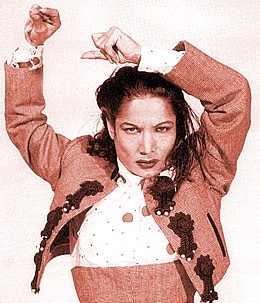
Carmen Amaya: the Greatest Flamenco Dancer of All Time

 The 100th birthday of Carmen Amaya, one of the legends of flamenco dance and song, will be observed in 2013. Barcelona, the native city of the legendary 'Queen of the Gypsies,' is already beginning to celebrate the centennial with the opening this weekend of the 1st annual Carmen Amaya Festival, organized by the Tablao del Carmen, one of the venues in the city's open air museum Pueblo Español. The event features guitarist Tomatito, singers Remedios Amaya and Montse Cortes, and flamenco dancer Manuela Carrasco, winner of Spain's National Dance Award in 2007.

Amaya never formally studied dance or voice, but began from the age of 4 as a street performer with her father. From the streets of Barcelona, she went on to perform on the city's stages before moving on to conquer the nation's capital, Madrid. When the Civil War broke out in 1936 she left Spain and began traveling and performing in the great cities of the world, including Lisbon, London, Paris, Rio de Jainero, Buenos Aires, Santiago, Caracas, Bogotá, Havana, Mexico City, and New York, where she debuted at Carnegie Hall. She went on to appear in Hollywood movies and in 1944 performed at the White House for President Franklin D. Roosevelt. After a decade abroad she returned to Spain as a wealthy international star. She continued to perform and travel the world over, including one more visit to the White House, this time at the invitation of President Harry S. Truman in 1953. Ten years later Amaya died of kidney failure at only 50 years of age.

Speaking to the newspaper El Periódico about this weekend's tribute, Tomatito, who is a world renowned musical artist himself, said that he hopes to demonstrate the 'connection' his playing has with the wild fury of Amaya.

"My guitar is connected to her. I am a Gypsy, just like Carmen."

Describing her as the greatest of dancers, Tomatito recalled stories that when people from his native Andalusia learned that unlike them she did not originate from the birthplace of flamenco, but rather from the northern region of Catalonia, the bemused attitude was usually one of, "Well, we all have skeletons in our closets." 

Video clips:

Clips from the documentary "QUEEN OF THE GYPSIES, a Portrait of Carmen Amaya"

Carmen Amaya in "Follow the Boys" - 1944

Carmen Amaya y su troupe por Bulerias - 1961

Monday, December 29, 2008

That well known Spanish singer -- Nat King Cole?!?

Until I moved to Spain and stumbled across some of Nat King Cole's Spanish language recordings, I had not known that he recorded songs other languages. In fact, he recorded three albums in Spanish: “Cole Español” (1958), “A Mis Amigos” (1959) and “More Cole Español” (1962) and at leas one additional song (“Tu Eres Tan Amable”- “You're So Nice”), which was posthumously released in 1983 on an album called album "Unreleased."

Although Spanish was the only other language he recorded entire albums in, he also recorded songs in Portuguese, Italian, French and at least one non-Romance language -- Japanese! And he did all of this without speaking anything but English! Instead he did what Tejana singer Selena did before she learned to speak Spanish – he memorized the songs phonetically.

His daughter Carole Cole said in an on-line chat with fans of her father that, “my father didn't actually speak Spanish. But...he recorded three albums in Spanish which he learned phonetically. He certainly had a deep admiration for Latin culture. And a number of friends from Mexico, Brazil and Cuba. In fact his manager, Caroles Gastel, was Cuban.”

She also agreed with a fan who claimed that Cole was one of the first English speaking singers to record in Spanish by adding, “this was another area in which I believe my father was a pioneer. You might be interested to know that in his travels throughout Latin America he was received with opened arms and an enormous amount of affection. For instance, when he first toured Brazil it seemed the population of Rio de Janeiro turned out en masse throwing roses at his feet to walk on, and he and my mother were asked to stay with the then-president of Brazil in the Brazilian palace. It's also interesting that he attempted to record in a number of other languages which needless to say, further endeared him to other cultures. He recorded Autumn Leaves in Japanese, which you can see in the documentary. I believe he recorded a tune here or there in Italian, French. And I imagine he would have done more in this area if he'd had the time.”

To me the history behind these recordings is a testament to Nat King Cole's ability to break down barriers. He obviously had to fight racism all of his life, and perhaps part of the reason he wanted to record in other languages was to extend that fight on some level. Two years before his first Spanish language recording he went to Cuba to perform at the Tropicana. He had wanted to stay at Havana's best hotel, the Hotel Nacional de Cuba , but was told it was fully booked. Although he discovered that he had been lied to and that in fact the Nacional had a White's only policy, he did not leave the island, but decided to honor his contract.

His engagement at the Tropicana ended up being so successful that he agreed to return the next year. In the mean time he applied himself to adding Spanish songs to his repertoire, with the help of Armando Romeu, a Cuban musician and arranger. After another successful appearance at the Tropicana in 1957, he again traveled to Havana in 1958 to record “Cole Español,” which was the first step towards a string of Spanish language hits – Acercate Más, Ansiedad, Aquellos Ojos Verdes, Perfidia, Quizás, Quizás, Quizás, etc.

The result was that long before the likes of Julio or Enrique Iglesias, Nat King Cole became the first truly "international" singing star. Today he is known in Spanish speaking countries as a singer of English and Spanish songs – and the Hotel Nacional de Cuba has a special “Nat King Cole Corner,” with a bust of the singer and a jukebox full of his songs. (See photo above.)

I've met many Spaniards who are familiar with these Spanish recordings, either because the songs were popular when they were young or because they discovered them through their parents or grandparents. One of my students remembers hearing the songs as a child and does a perfect imitation of Nat King Cole, including his pronounced gringo accent. Even I sometimes have to smile when I hear how strong his North American accent is – and I have a pretty strong one myself.

Despite the non-native accent, the songs are lovely, with lush arrangements and, of course, that beautiful, buttery baritone. As the title one of his songs goes, Fantástico!

Saludos amig@s,

Carloz

P.S. Enjoy the 3 songs from YouTube! / ¡Disfruta las 3 canciones desde YouTube!


Sunday, May 4, 2008

Barcelona's April Fair - Feria de Abril


Today is the last day of the 37th edition of Barcelona's April Fair. Some of you may be thinking, “Why does a so-called April fair happen in May?” – and those of you who know Spain may be asking, “Isn't the April Fair held in Seville each year?”
.
Well, the original April Fair, which was first held in 1847, is the one that occurs in Seville each year. It usually starts two weeks after Semana Santa (Holy Week). There are also smaller April Fairs held in several Andalusian cities and towns at around the same time.
.
In 1971 immigrants to Barcelona from Andalusia, and their descendants, began their own version of this rite of spring. Today Barcelona's is the second largest April Fair in Spain, rivaled only by the one in Seville. This fair typically runs from the last week of April through the first week of May.
.
So, just what is an April Fair? Well, first and foremost, it is fun. Secondly, it's an opportunity to revel in Spanish, especially Andalusian, culture – flamenco, sevillianas, rumbas, boleros, pienetas, mantillas, shawls, riding jackets, castanets, cantaores, bailaoras, Jerez sherry, manzanilla wine, tapas, gazpacho, ham, and, my favorite, the Spanish confection churrrrrrrrros!
.
In Barcelona's version, the April Fair is also a celebration of multiculturalism. This is in recognition of the fact that Catalonia absorbed hundreds of thousands of “internal immigrants”from Andalusia, Murcia and Extremadura during the 50s, 60s and 70s and is now absorbing a new wave of immigrants, but this time from Latin America, Morocco, Pakistan and Eastern Europe. Indeed the current President of the Catalan government, José Montilla, was one of these “immigrants” from Andalusia, having relocated with his family to Catalonia when he was 16.
.
Because of all this, aside from the typical pavilions (casetas) dedicated to towns in Andalusia, you can find others like the Casita Latina, the Centro Cultural Gitano La Mina (The Gypsy Cultural Center of La Mina) and the Moroccan pavilion, with food, drink and gifts on sale in support of El Colectivo para la Defensa y la Protección de las Constantes Sagradas del Reino de Marruecos (The Collective for the Defense and Protection of the Sacred Attributes of the Kingdom of Morocco). In addition, visitors to the festival are a mosaic of people from around Spain and the world. However, there are usually not very many tourists. For that last reason, I find it a particularly authentic experience.
.
Another difference between the events in Seville and Barcelona is that in Seville the pavilions are privately owned and one must be an insider of sorts (e.g., a family member or friend, a member of an organization or willing to pay a lot of money) to gain entry. While in Seville members of the public can walk around and “press ones nose to the glass,” metaphorically speaking, at Barcelona's more egalitarian event anyone can walk into a pavilion, sit down and, if they dare, dance! In Seville, the pavilions are decorated, but tend to all look similar from the outside. In Barcelona pavilion interiors and facades are colorfully, often cleverly, decorated -- and in Barcelona, there is a even a contest for best decor!
.
Each year the sponsoring organization, FECAC (Federación de Entidades Culturales Andaluzas en Cataluña = Federation of Andalusian Cultural Groups in Catalonia), chooses the top three pavilions, as well as the best interior and best facade. This year there were 58 pavilions and the prizes went to:

All the pavilions of Barcelona's Feria de Abril are welcoming places where members of the public can rest from walking around the fairgrounds, buy a drink, eat a meal, snack on tapas, listen to music, watch dancers, or get up and dance. Most of the pavilions are sponsored by cultural associations created by and for Andalusian immigrants and their descendants. There are also pavilions sponsored by political parties from just about the entire spectrum. In addition to pavilions, there are stalls selling clothing, arts, crafts, and food items from around Spain. There is also a fun-fair for kids, with a Ferris wheel and other rides, as well as little stands selling hot dogs, ice-cream, cotton candy, drinks and, of course, churrrrrrrrros!
.
Admission to the fairgrounds is free. Prices in the pavilions are regulated by the fair organizers, but prices in the stands and stalls are not. So, the best deals are on food and drink often in the pavilions.
.
The entire thing is an 11 day feast of sight, sound, smell, touch and taste. And the joy is contagious – whether its that of the professional dancers on the stages, the colorfully costumed bands of singers & dancers who roam around the grounds or the civilians strutting their stuff on the pavilion dance floors.
.
¡Viva la feria de abril!
.
Carloz
.
P.D. Y, ¡viva los churrrrrrrrros!

Sunday, July 1, 2007

Spain’s Saturday News Highlights: The pájaros are coming! Will the Ratistas, too? Well, golf won’t be coming to Girona

Originally posted by Carloz on 30 June, 2007 at http://myspainblog.wordpress.com/

Singer-songwriters Joaquín Sabina (Andalusia 1949) and Joan Manuel Serrat (Catalonia 1943) started their Dos Pájaros de un Tiro (Two Birds in One Shot) Tour to a standing-room only crowd in Zaragoza last night. For the next six months the singers, who were icons of the transition to democracy in the 70’s and 80s, will perform more than 60 concerts throughout Spain and Latin America.

Both were exiles during Franco’s rule — Sabina living in London and Serrat in Mexico. Until now Sabina and Serrat were not a duo, but two indivdual stars with their own styles and hits. For the tour they are performing each others songs jointly and individually. The two will reach Madrid in September (three concerts scheduled, two already sold out) and Barcelona in October (two concerts, one already sold out). The final concert of the tour will be in Montevideo, Uruguay on December 20th.

Here’s the tour’s official web site: http://www.dospajarosdeuntiro.es/

More re Rato: Speculation continues about IMF chief Ricardo Rato’s early resignation and planned return to Spain this autumn. There was talk in the media today of Rato followers making preparations to convince him to return to Spain’s political life as well. El Pais pointed out that Popular Party leader Mariano Rajoy doesn’t have one “Ratista” on his team.

Conservationists applaud decison to halt two housing construction plans in Catalonia: The Planning Commission of Girona Province has rejected a proposal to build 1,000 new homes on 85 hectares in a woooded area situated between the developments of Lloret Blau and Lloret Verd in Lloret de Mar. The Commission also denied permission to construct 370 new homes and a golf course in Garrigoles, where only 155 people currently live. In their campiagn against the golf course, conservationsists crossed out the name of Garrigoles on the sign at the entrance to the town and hung one with “Garrigolf” next to it!

Responses

By: Colin on July 1st, 2007 at 2:35 am

Too many golf courses in Spain as it is - though having said that I guess they bring money into the country and provide jobs for people.

By: Carloz on July 1st, 2007 at 12:35 pm

Yes, too many golf courses — and way too many houses!! As the European Parliament declared recently, the huge construction projects do not respond to real needs of the people of Spain! (See: http://myspainblog.wordpress.com/2007/06/22/in-fridays-news/) What Spain needs more of is sustainable development and efforts to diversify its job market. While I think it’s basically a good thing that Spain has such a great tourism industry, there really needs to be a push to develop jobs in areas other than leisure and tourism.

Thursday for this English teacher in Spain - Music before class!


This article has been updated and can be found on my Newsvine column.
Here's a link to the article: A Thursday For This English Teacher in Spain