Showing posts with label public transport. Show all posts

Sunday, March 30, 2008

Happy Birthday Bicing!


Bicing, Barcelona's public bicycle sharing system, marked its one year anniversary with a party on the seaside this weekend. About 2,000 persons gathered to hear speeches, watch marching bands, and eat a giant birthday cake.
.
From the perspective of this user Bicing is a success and I think most Barcelonans would concur. Using this form of public transportation has saved me time and money, as well as provided me with an opportunity to get some extra exercise -- all without contributing to air pollution, noise and traffic congestion.
.
Here are some statistics provided by Bicing that reflect the program's popularity: today Bicing has more than 130,000 users from 16 years of age to 83. The majority are between the ages of 26 and 35. The 4, 300 bicycles are used an average of 30,000 times a day. Each bike is used an average of 8 times a day. The average trip lasts 17 minutes and covers 3 kilometers. There are currently 286 stations that cover every district within the city limits. About 120 workers travel around the city in special Bicing vans to make repairs, switch out damaged bicycles and provide station maintenance. Every day about 300 new people join the system by paying the 24 euro annual membership fee.
.
Future plans include expanding to 400 stations and 6,000 bicycles by this summer. Neighboring cities, such as Badalona and L'Hopsitalet, are considering joining the network so that Bicing can cover the whole Barcelona metropolitan area. There is talk about increasing the program's operating hours. (Currently the service is available from 5am to midnight on Sunday through Thursdays and 24 hours on Fridays and Saturdays.) Plans to create a weekly pass for tourists have been put on hold, but stay tuned, because as soon as it is inaugurated, I will post a notice.
.
However, the system is not perfect and not all users are happy. One anonymous commentator on the ADN.es website wrote:
"It's a shame that you do not mention the very bad management of this service: thefts of bells and damage to gears, insufficient availability of bicycles at stations, failures in the computer system that prevent you from taking a bicycle even though some are available, fines and unjust sanctions due to mistakes by those in positions of responsibility..."
(Click here for the original Spanish version of the article the writer was commenting on. Scroll down the page to view his comments.)
.
This writer is referring to the following situations:
  • some of the bikes are vandalized, forcing users to ride without bells or with non-functioning gears;

  • at times there are no bikes available at a station and it is necessary to wait until someone returns one -- indeed sometimes there are lines of people waiting for a bike;

  • the computerized station racks sometimes breakdown and either will not allow people to take bikes or will not allow bikes to be returned;

  • and some members claim that they have been fined 250 euros for losing bikes that in fact they had returned.
The latter could be because of a problem with the computerized rack, but it could also be because the user did not check to make sure that the bicycle was locked into the rack properly. I have actually seen kids at the Bicing bike racks trying all the parked bikes to see if there are any bikes that they could take be cause they were not locked properly.
.
Of course, the burden of proof is on the member. For that reason, I usually not only check to see that the rack has properly locked the bicycle by trying to remove the bicycle from the stand, but I also immediately try to check out another bike because if the system has recorded the bike as returned, the computer system should give me a message that I need to wait 10 minutes before borrowing another bicycle.
.
Other things I hear people complaining about are the limited number of bike lanes in Barcelona, the lack of respect pedestrians and other vehicles have for bike lanes, and the fact that police seem to fine bicyclers for violations much more than they do pedestrians and vehicle drivers. (I've never heard of a pedestrian getting fined for walking in a bike lane, although it is against the law.)
.
So, yes, there are problems but all in all, I have to say I am not only satisfied, I am grateful. Bicing is a great way to get around!
.
¡Felice cumpleaños, Bicing!
.
Carloz
.
P.S. Bicing has an old English version of it's website that is not updated anymore. Click here to view it.

Sunday, October 7, 2007

Bicing, bicycling and the law in Barcelona

Barcelona recently updated it's law concerning the flow of traffic -- motor, two wheel and pedestrian. A few of the major aspects of the law that effect bicyclers are: being allowed to ride in the middle of a lane, having to stop at red lights, not being allowed to use lanes reserved for buses and taxis, being prohibited from riding on pedestrian sidewalks smaller than five meters wide, having to use bike lanes when they are physically separated from the street (if they are not physically separate, then it's optional) and having to have functional bells and lights.
.
I think many people believe the law is an improvement over what existed before, but there are still many concerns. One of mine is not being allowed to use the bus/taxi lane. On a street like Via Laietana that means having to ride in the middle lane, with taxis and buses whooshing by to your right and passenger vehicles and trucks zooming by on your left. It's a little nerve racking!
.
Then there is the fact that the bikes available through the Bicing public transportation program often have bells and lights that are missing or broken. I mentioned that to a Bicing staff person the other day and the response was, "Don't worry, the police won't fine Bicing users for that. They understand that it's not your fault." OK, but what about the reason for requiring lights and bells -- safety!
.
Anyway, below is my translation of parts of a report about some of these issues from today's El Pais. The article was drawn from a reporter's one hour observations of a busy Barcelona intersection.
.
"Motorcycles, cars, parking, driving, unloading, walking... Some of everything can be found in the C/ Consell de Cent bike lane between C/ Pau Claris and C/ Roger de Llúria. Last Tuesday between 11.30am and 12.30pm saw the frantic business day activity of every kind of vehicle, including bicycles - the only ones that, in theory, should be using the bike lane -, and often causing them to leave the lane in order to negotiate obstacles in the shape of parked vehicles. In the hour observed, it was not only motor vehicles that violated the traffic code, but also cyclists who did not respect the ordinance -- red lights were run and sidewalks less than 5 meters wide were ridden on.
.
In one hour the balance of bike lane infractions was as follows: 14 vehicles parked in the bike lane, 3 taxis dropped off and collected passengers, a large number of motorcycles (too many to count) drove along and 12 motorcycles stopped for the light inside the bike lane. Violations by bicyclists were: four bicycles ran the light, four others rode circulated along the sidewalk. And a pedestrian also decided to walk along the lane. By type of vehicle, the results were: 29 of motor vehicles invaded the bike lane, 9 bicycles violated the ordinance and one pedestrian walked in bike lane.
.
During that 60 minute period, only one police officer came by -- one of those who patrols on a bicycle. He gave a warning to a bicyclist who was riding along the sidewalk and ticketed a car parked in the bike lane.
.
The biggest danger occurred when more than one van or car was parked, causing cyclists to zigzag continuously and dangerously. A total of 33 bicycles had to leave the lane to avoid parked vehicles, with all the danger this involved. Actually, more than a few opted to stop and wait to exit the bike lane until no cars or motorcycles were coming.
.
The number of infractions counted by this newspaper in an hour along one city block demonstrates that vehicles do not respect the bike lane and invade it constantly, putting cyclists at risk. And it also it provide evidence that reality far surpasses official figures. According to data provided by the Guardia Urbana, between January and September of this year -before the new ordinance took effect - the following infractions were reported: 1,295 for parking in a bike lane, 15 for stopping in a bike lane, 1,674 for driving in a bike on a motorcycle, 493 for driving in a bike lane on a moped, and 34 for driving in a bike lane in a four wheels. This newspaper requested from Barcelona City Hall the number tickets issued for the same infractions since the application of the ordinance, but received no response. Lacking concrete data, the Bicycle Club of Catalonia (BACC) believes that the ordinance is being applied to bicyclists above all.
.
"The most frequent bike infraction is running a red light. But the same zeal is not seen in sanctioning vehicles that invade bike lanes", stresses Diana González.
.
This worries cyclist organizations because of the growth of users of this means of transportation due to the appearance of the Bicing program. Before Bicing's establishment, there were some 40,000 bicycle trips each week day in Barcelona. Now there are more than 70,000."
.
And I'll close by adding that that number is sure to keep growing.
.
If you'd like to read the complete article in the original Spanish, click here.
.
Hasta luego amig@s,
.
Carloz

Wednesday, August 15, 2007

From the seaside to the hillside - Part 3 (Vallvidrera)

In my opinion, Vallvidrera, which is perched on the crest of the Collserola hills above Barcelona, is one of the city's loveliest neighborhoods. To get there, I usually take the FGC from Plaza Cataluña. (FGC stands for Ferrocarrils de la Generalitat de Catalunya, which is the name of the Catalonian government railway system. Within the city, FGC trains run underground, but outside the city they climb out into the light. Barcelona's transportation system is completely integrated as far as fares and tickets go. So, a pass for the metro is also a pass for the FGC.)
.
Directly in front of Café Zurich are two entrances to the underground Metro and FGC stations. From either of these two entrances one can enter the FGC station. To get to Vallvidrera take any FGC train except the one to Av. Tibidabo. There are television screens throughout the station indicating when and from which track the next train leaves. Since there are trains leaving every few minutes, it's usually possible to hop on a train immediately. I've never had to wait more than about 5 minutes.
.
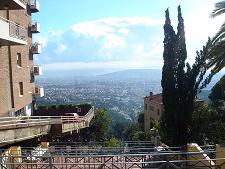
After a short ride, it is necessary to get off the train at the Peu del Funicular station and transfer to the modern little funicular that goes up to Vallvidrera. This funicular station is located in an area known as Lower Vallvidrera (Vallvidrera Inferior). The transfer is easy and fast at this little open-air station; and the ride up the hill, in metal and glass cable cars manufactured in Switzerland, offers some excellent views of the city and sea below. The best views are from the seats in the back of the car.
.
The funicular's hours are 4:30am to 12:15am weekdays and 5:30am to 12:45am weekends and public holidays. Cars run every 6 minutes on weekdays and every 10 to 15 minutes on weekends and public holidays.
.
Although one wouldn't know it from the sleekly contemporary appearance of the Peu de Funicular station and cable cars, this line has been in operation since 1906, when the rail line was extended from Sarrià to Lower Vallvidrera. It wasn't until 1998 that the funicular was converted into the totally automated system it is today.
.
There is only one stop between Lower and Upper Vallvidrera: the tiny Carretera de las Aguas (Water Road) station. At this stop it is common to see hikers and bicyclers getting out. However, I usually prefer to ride to the top and then walk down to the Carretera.
.
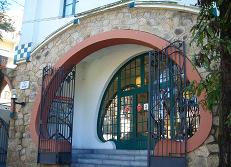
Next comes Upper Vallvidrera and a fantastic remnant of the 1906 line -- the modernist art nouveau Vallvidrera Superior station. Walking around this little jewel of a station, with its voluptuously curved windows and entrance, is like stepping back in time to the era of Gaudi. Constructed in 1905, the station was designed by the architect Bonaventura Conill i Montobbio, who who designed a good number of the buildings in Vallvidrera. Make sure to visit the viewing platform at the back of the station's lobby.
.
From here it is possible to take a city minibus (line 111) to the top of Mount Tibidabo, where a large church sits on top of an amusement park overlooking the city. Since Vallvidrera is actually surrounded by the protected Collserola Natural Park, it is also a great place to start off for a hike in the woody hills. Before doing anything else, however, get to know this quaint little neighborhood a bit.
.
The earliest known reference to Vallvidrera appeared in 987, in a document referring to the church of Santa Maria de Vallvidrera and a Gothic style church by that name was built between 1540 and 1587, and is located in what today is the park of Collserola. In the 14th century the "parish" became a "civil jurisdiction." In 1892, what was then the town of Vallvidrera was annexed by the town of Sarrià, which was then annexed by Barcelona in 1921.
.
Despite this long history, major urban development didn't begin in Vallvidrera until the second half of the 19th century, when the characteristics of the area a¡changed from that of a village to a location for summer homes of the increasingly prosperous citizens of Barcelona. A "modern" road was not built to link it with the city until 1888, when the Vallvidrera to Tibidabo roadway was constructed. In 1901 a tram was inaugurated to link Barcelona, Tibidabo and Vallvidrera. In 1906 the funicular connected the area with Sarria. At this time Vallvidrera became a popular summer residence for wealthy Barcelonans. Today it is a handsome residential neighborhood with the characteristics of a small, prosperous town.
.
Directly across from the funicular station is Plaza Pep Ventura. Walking around the little square and the streets surrounding it, one is surrounded by superb views. Walk to one side of the plaza and gaze over the tiled roofs of lovely little houses out onto the green valley below and the Montserrat massif looming in the west. Most of the houses date to the early 1900s, as can be observed by the years inscriptions on the gables. (One house even has a Catalan poem inscribed on it!)
.
Head to the the east along C/ de Queralt, which changes from a street to a series of pedestrian steps. Look between the houses to the left for some great vies of the city. At the foot of the steps you will find the main square of the neighborhood, Plaza de Vallvidrera. Stop in at for a coffee and a sandwich at Bar Josean, which has a back sitting room with an incredible view of Barcelona and the Mediterranean. Nearby, the Can Trampa restaurant doesn't offer much of a view but is a good little spot for lunch or dinner. The plaza also hosts a modernist style wine and cheese shop, as well as a bread shop and a convenience store. One block to the north is the Mercado del Vallvidrera at C/ dels Reis Catolics 2, which sadly is set to close.
.
Walk back to Pl. Pep Ventura along C/ de les Alberes for more fantastic views of the valley leading to Montserrat. Once back at the Plaza, walk up the "street" stairs of C/ dels Algarves. More lovely houses, this time a mix of old and new, will lead you to the Hotel Vallvidrera, dating from the 1900s. Today it is a well maintained senior citizens' residence. It is easy to imagine what the place must have looked lime in its heyday.
.
At this point C/ dels Algarves rejoins C/ de les Alberes. Continue east along Alberes a bit and on the right you will find a steep "stair street" called Escales del Font del Mont carved into the side of the hill. This is one of the ways to reach the Carretera de la Aguas (Water Road) below. At the bottom of the stairs take a right on Torrent de la font del Mont and walk down until it ends at the Carretera de las Aguas. Once you reach this gravel road, head to the left and walk for about 10 minutes to find yourself in a peaceful wooded area overlooking the panorama of the city and the sea. Breathe in the fresh air, have a seat on one of the benches built alongside the road, walk through the trees above the road -- in other words, relax.
.
When you are ready to return to the buzz of the city below, head back in the direction you came, and after about a 5 minute walk beyond the entrance to Torrent de la Font del Mont, where you entered the road, you will find the Carretera de las Aguas (Water Road) funicular station. On the ride down you can enjoy one more glimpse of Barcelona stretching from the hillside to the seaside.
.
Carloz

Monday, July 16, 2007

Then there's Madrid...


...which is another great Spanish city. I lived there for almost two years and thoroughly enjoyed it. I recall a New Yorker I met there when she was taking a TEFL certification course. After completing the course she went to Paris to join her boyfriend, but a few weeks and a break-up later, she returned to Madrid to teach English for a year. She liked the city so much she returned the following year to teach there again. I remember her telling me near the end of her second stint in the capital that, although she only went to Madrid after the break-up to be in a supportive environment with friends she'd made during her TEFL course, she was glad that it worked out that way because otherwise she might never have known how nice a place it was.
.
This young woman had lived in London, Paris and Stockholm and here she was rating Madrid along with these other European cities. In fact, she described it as one of Europe's best kept secrets. Over the years I've heard others say similar things when singing the city's praises. Well, perhaps the the cat is finally out of the bag.
.
According to a news report in EL Pais, a study by the Organization for Economic Cooperation and Development (OECD) has found that the Spanish capital is one of the best cities in Europe. In fact, the paper quoted the director of the study, Mario Pezzini, as having said, "We liked it so much that if we had to leave Paris, the members of the team would move to Madrid."
.
The OECD report claims that among Madrid's strengths are its public transport system, low unemployment and successful integration of immigrants, who currently make up 16% of the city's population. On the negative side, the report highlights traffic congestion, low spending on Research and Development and the high rate of temporary employment.
.
Overall, however,the OECD team members found Madrid a "prosperous space" with high demographic and economic growth, according to another news source, Diariocrtico.com. The report apparently cites proactive public policies as one of the reasons the city's attraction and quality is improving.
.
All of this must be good news for Mayor Alberto Ruiz Gallardón, who reportedly wants to gain more power within the conservative Popular Party (PP) and enter national politics. He's seen by many as a moderate voice within the PP, not unlike Rudolph Giuliani in the U.S. Republican Party.
.
Another goal of his is to see Madrid host the Summer Olympics. Although the city's bid for the 2012 didn't win, it did receive good marks. Therefore, the OECD report is probably equally welcomed by the Spanish Olympic Committee (Comité Olímpico Español), which is working on the application due to the IOC by September 13th.
.
So, that's a little update on Madrid, the capital, the center of the country, the largest city in Spain and apparently not such a secret anymore.
.
Chao amig@s,
.
Carloz

Saturday, July 14, 2007

A Tale of Two Cities: Barcelona Bicing & Paris Vélib


Hey, I see that Paris will be starting its own public bicycle transport program tomorrow. It's called Vélib which is a mix of the French words for bike (vélo) and free (libre). I say bon for them!
.
Here's my 2 cents worth of a comparison between it and Barcelona's Bicing program.
.
Bicing vs Vélib, the names: To me "Bicing" is a much catchier and international sounding name. I mean, "veleeb parreee" sounds OK, but Barcelona Bicing, that's snazzy, rhythmic, alliterate, mnemonic. (By the way, it's pronounced "beecing.")
.
Bicing vs Vélib, the websites: The Bicing website is available in Spanish, Catalan and English, to make it more accessible to the city's cosmopolitan population. The Vélib website is available in French and, well... er... French, to make it more... er... French! Chalk another one up for Barcelona Bicing. Acreditase un mas a Barcelona Bicing. Acredita-se un mes a Barcelona Bicing.
.
Bicing vs Vélib, the water-side view: Yeah, yeah, yeah, biking along the Seine sounds romantic and like something Judy Collin's grand kids probably do. However, it's really just a little river and no amount of Paris plage-ing during the summer is going to make it feel like the MEDITERRANEAN! Barcelona Bicing on the beach is the winner here.
.
Bicing vs Vélib, the weather: Biking in Paris during the summer may be nice, but really, who wants to bike in Paris on a cold, gray winter day? During the winter most Parisians are probably looking at Spanish travel brochures and dreaming about THE MEDITERRANEAN!! Summer, winter, spring or fall, wouldn't you rather be Barcelona Bicing on the beach?
.
Bicing vs Vélib, the sites to see: Ok, both cities do really well in this category. Eiffel Tower, Sagrada Familia, Champs-Élysées, Las Ramblas, Arc de Triomphe, Arc de Triumf, etc., etc. etc. Paris may even have the edge here... but... come to think of it, we've got the foothills of the Pyrenees to look up to when we're tooling along Paseo de Gracia! Can one bike from the sea to the mountains in Paris? Creo que no.
.
Bicing vs Vélib, the population: Would you rather bike in a city of about 1 and a half million people, like Barcelona, or about 2 and a half million, like Paris? (Now before you answer, don't only think of the heavier traffic, but remember those cold, dreary Paris winters and the sun shining on the Mediterranean all year long.) OK, Barcelona Bicing on the beach wins here, too.
.
Bicing vs Vélib, the rates: Bicing 24 euros annually; Vélib, 29 euros. BBOTB.
.
Bicing vs Vélib, the countries: Bicing's in Spain, the other's in France. I rest my case.

Barcelona Bicing on the beach, yeah! Barcelona Bicing on the beach, yeah! Barcelona Bicing on the beach, yeah!

Wednesday, July 11, 2007

Walk, ride or drive?


I was surprised to find out recently that while an estimated 45% of Barcelonans get around town on foot most of the time, only 14% of us use public transport habitually. This is according to a study conducted for the Catalan government (the Generalitat) and the Metropolitan Transit Authority. The study also found that 40% use a personal car regularly.
.
What was even more surprising was to read that more Madridleño's use their city's public transport system than we do! This is according to a report by the by the "Consejería del Transporte" (Transport Council) cited in the free daily newspaper Que! The study reportedly found that regular public transport use is at 74% in the capital city! Nothing was mentioned about cars or pedestrians, however.
.
When I lived in Madrid there were an awful lot of cars and traffic jams. The streets seemed crowded with pedestrians, too. To tell the truth, the metro did often seemed pretty packed. Just like Barcelona! Hmmm, makes me think of the old expression, "there are lies, damned lies and statistics."
.
Well, something I am sure about is that both cities have excellent public transport systems and both are great for walking. Barcelona's public transport authority seems to me to be particularly innovative -- for example, the "Bicing" bicycling program I've written about before. As for walking goes, it is nice to know that almost half of my city's residents use this method to get around daily.
.
As a matter of fact, it's about 9pm, the sun is setting and this is a perfect time for an evening "paseo." I think I'll do just that!
.
¡Chao amig@s!

Sunday, July 8, 2007

Spain's Sunday News: Dalí, Photos, DNA, Music and Money, Money, Money, Money


Dalí Photos - El Pais announced today that Salvador Dalís former photographer and personal assistant, Robert Descharnes, is exhibiting 147 of the thousands of photos he took of Dalí and his muse, Gala, at the Municipal Museum of Cadaqués until January of next year. The photos focus on the Catalan artist's relationship with the coastal town and the nearby village of Port Lligat.
.
The 83 year old French photographer said he is computerizing and cataloguing the more than 60,000 photographs that he took of Dalí and Gala over 40 years of friendship with the couple.
.
Note: this photo (Dalí with ocelot) was not taken by Robert Descharnes, but by Roger Higgins.
.
Dalí DNA - Descharnes revealed to El Pais that he has provided samples of Dalí's DNA to American scientific experts for the purpose of obtaining the genetic map of the surrealist icon. He apparently obtained the samples from the tubes inserted into Dalí's nose when the painter was last hospitalized. Descharnes claims that due to Dalí's genius a study of his DNA would contribute much to science.
.
Test for buskers - Musicians now have to pass a test in order to perform in the Metro, Barcelona's subway system. El Pais reported that some 80 musicians auditioned yesterday before officials of the Street Musicians Association of Barcelona (Amuc BCN) and the Barcelona Transportation Metropolitan agency for permission to perform in Metro stations and trains. "The objective is to guarantee minimum standards," stated Hugo Guerrero, president of Amuc.
.
Until now, permission to perform was given to anyone who registered with Amuc. Esther Ayala of TMB explained that the audition was organized because the previous system did not work well, which resulted in people who did not really know how to play or sing performing.
.
Reportedly many of those who tried out yesterday were Latin-American guitarists and Eastern-European accordionists and the most were successful in their bids. "Between 85% and 90% were approved," according to Guerrero.
.
Have you seen any 500 euro bills lying around? Apparently there are over 113 million of them in Spain, worth over 56,529 million euros, but they aren't seen very often. Spain's Tax Office has been has been investigating the situation for years, but to little avail. In fact, this past May a record number of 500 euro bills in circulation was reached, according to the Bank of Spain -- 64,3% of the total currency in Spain!
.
Spaniards humorously refer to the bank notes as "Bin Ladens" because hardly anyone claims to have seen one. El Pais noted that over the past year the number of 200 euro notes in circulation has increased, too -- from 19 to 21 million.
.
What do you think is going on?!

Wednesday, July 4, 2007

Will success kill 'Bicing', Barcelona's new public bicycling system?


Below is my translation of an article by JAUME BAUZÀ from last Sunday's El Pais newspaper.
Click on the title below if you want to read the original Spanish version.
.
Success threatens to drown 'bicing'
.
In biology it is said that an insect survives because it is small, but that if it grew to the size of a cow, it would suffocate. Something similar could happen to Bicing, with its overwhelming success in Barcelona.
.
The public transportation system established by City Hall last March has already has attracted 70,000 users so far -- a figure that grows by 1,000 new subscriptions a day. However, the number of available bicycles is much lower: 1,500 located at 100 stations. This difference between supply and demand is starting to cause problems in getting hold of a bicycle.
.
Empty stations for much of the day, queues to get hold of one the prized methods of transport and users who, after an initial phase of skepticism followed by enthusiasm for the innovative service, are beginning to grow impatient.
.
"The other day I had to go to three stations until I found a bicycle. If it to had gone home on foot since at the start, I would have arrived there earlier," said Ana at a stop near the cathedral.
.
"At first there was no problem, but when I leave for work it's a miracle to find a bike," claimed Antoni in the Eixample area.
.
Although the majority of users consulted believe that Bicing is an excellent initiative, a lot of criticism was expressed about the lack of bicycles. Nevertheless, those responsible for the program are not worried.
.
"I don't believe there is a serious imbalance between supply and demand. At any rate, the service is still not up and running 100%," stated a spokesman of Barcelona Municipal Services, the public business that operates the new urban transportation system. City Hall foresees by year's end 3.000 bicycles in circulation, distributed through 200 stations all over the city. But how many users will have registered by then?
.
"Now we are in a state of flux. With the summer's arrival the promotional [membership] rate of six euros annually has ended. It doesn't seem probable that the number of requests will continue at this pace after September."
.
The system is seen as an alternative method of public transportation, so it only allows for trips of half an hour. In case that time limit is surpassed, the user is penalized 30 cents. This way the bicycles move constantly. Clear Channel, the company that put the service operation in Barcelona, reported that there have already been more than 500,000 trips recorded.
.
"According to our calculations, each bicycle is used an average of 12 times a day and we believe that those rotations will rise to 15 by the end of the year. So when they say that there are few bicycles, one must keep in mind that they are in continuous movement," City Hall said in response to the criticism.
.
At Barcelona Municipal Services, they prefer that things develop naturally. "It's logical that in the future some users will drop the service, having tired of not finding a bicycle. Thus the supply and demand will balance out," explained the municipal spokesman. "At any rate, it's still very early to speculate on that question. The system is new. We started from scratch and we need a year to study where the gaps are and find solutions", affirmed this spokesman.
.
The advantages of Bicing are undeniable and explain why Barcelonans have been tripping over their feet to get at this service. It's comfortable, ecological and cheap. According to a profile provided by City Hall, the average user is more than 35 years old (48%), is a professional with an advanced degree (30,6%), lives in the Eixample (26,4%) and uses the bike an average of 15 minutes.
.
To absorb such user demand, the town council is working towards installing a new station every day. The Bicing map already includes 75 stations that extend all over the city. For example, the six kilometers that separate Plaza d' Espanya and Glòries can be covered in 28 minutes traveling almost in straight line along Gran Via. The stress and heat produced by cars in two lanes, pedestrians that cross the street without looking and furious cabdrivers suggest making the return trip by Metro. The eight stations that separate both Plazas require 12 minutes travel time.
.
Such a system is necessary, many citizens say, above all in a metropolis that has always boasted of treating bicycles well. But success can also kill and the flood of users threatens to reduce the effectiveness of the service.
.
"There are things that need fine tuning, but in July we'll have 150 maintenance and distribution staff, 10 vehicles with trailers to carry bicycles and another four vehicles for maintenance. So, we'll fill up empty stations more quickly," pronounced City Hall.

Sunday, July 1, 2007

An English Teacher’s Saturday in Spain!


This article has been updated and can be found on my Newsvine column.
Here's a link to the article: An English Teacher's Sunny Spanish Saturday

Biking with Bicing in Barcelona


Getting around Barcelona got more interesting with the introduction of “bicing” in April. The word “bicing” is an adaptation of the word “bicycling” and is used as the name for BCN’s latest addition to public transport. It’s great: sign-up via the interent, pay a small annual fee (24 euros), receive a member card a couple of days later and then use it to “check out” a bike for up to two hours at a time. The first 30 minutes are free. If you use the bike longer you pay 30 cdents for each half hour.

So, this afternoon I used the system to get to and from for my routine outing for Sunday lunch over the El Pais newspaper. I grabbed a bike from a stand a few blocks from my apartment and rode it to another stand located near one of my favorite seaside restaurants. A few hours later I collected another bike from the stand and rode it back to the stand in my neighborhood. There are five stands within walking distance of my apartment!

This bicycle lending service is integrated into the city’s bus and subway system. As I said earlier, it’s only been available for a few months and it is already extremely popular. The overwhelming success of the program surprised its developers. I read somewhere that they had projected 15, 000 people signing up by the end of the year. However, 30,000 people subscribed in the first 2 months!

I have been using the system for getting to work as well as for pleasure rides. Of course, since I teach at various locations around the city each day, it’s not possible to ride a bike to all of my classes. However, when a trip to a class involves a bus ride and a transfer to the metro, I can often substitute a bike ride for that bus ride and at least part of the metro ride. It is nice to be out in the open air instead of on a bus or down in the metro. (Although Barcelona’s bus and metro system is very good.) Another pleasant aspect is that since Barcelona is such a style concious city, the bikes and their stands are very nicely designed.Here’s a link to the English version of the Bicing web site:

Barcelona is a pretty progressive place. Well, all of Spain is, really. I am fortunate to live in this country.

5 Responses

By: In Today’s News: David Beckham Ends Madrid Stint with a League Title « My Spain Blog on June 18th, 2007 at 11:29 pm […] Bicing, Barcelona’s public transport by bicycle program, now has over 50,000 subscribers! […]
.
By: Pedalling Along on June 19th, 2007 at 4:33 pm
[…] I think if the planets are alligned, people would be willing to give it a try. I ran across this entry about a new bike service in Barcelona, Spain that is taking off. Could you imagine dedicating […]
.
By: pixelus on June 20th, 2007 at 5:36 pm
How I wish this was already existing when I lived in Barcelona a long time ago!
.
By: Carloz on June 20th, 2007 at 10:27 pm
Well, come back, Pixelus!
.
[…] Then I thought, hey, I always stay here in Barceloneta for San Juan. But I wonder what’s happening even further up the beach? Even to the other end? And then I knew how to find out — Bicing, the Barcelona public transit system’s bicycle lending service! (See June 17th post, Biking with Bicing in Barcelona.) […]

Copied from original http://myspainblog.wordpress.com/ posting by Carloz on 17 June, 2007