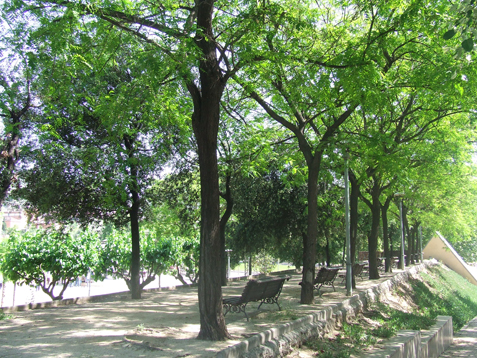
Tomé estas fotos el día de Navidad durante un paseo por el parque Cuña Verde, uno de los parques que rodean mi barrio. Felices fiestas, Carlos
Showing posts with label Parks. Show all posts
Saturday, December 26, 2015
Christmas Day 2015 Photos Madrid Fotos del Día de Navidad 2015
Tomé estas fotos el día de Navidad durante un paseo por el parque Cuña Verde, uno de los parques que rodean mi barrio. Felices fiestas, Carlos
Sunday, March 9, 2008
From modern Barcelona to an ancient Iberian village (Pueblo Iberico) Part 2

Walking uphill on Puig Castellar Ave. soon brings you to the neighborhood public market, Singuerlin, which takes it's name from the barrio. Although it is in a rather uninteresting modern building, it still boasts the usual vendors of fresh fish, meat, cheese, fruit, vegetables, nuts, bread, etc. Indeed, it's a good place to pick up items for a picnic in the wooded hills of the Serralada de Marina park above.
.
Turn left at the market on Singuerlin Street and then take a right on Catalunya Ave. to continue the steep walk through the neighborhood of apartment buildings and single family dwellings -- some ugly, some attractive, some plain. When you reach the end of Catalunya Ave. at Primavera Ave, take a left and walk until it ends at Ausias Marc Street, where you take a right until this little street ends at the intersection of Dante and Roger de Flors. Look to the left for the stairway built into hillside, which goes up to Garcilaso de la Vega Street, where you turn right. Up ahead is a little circle with a city bus shelter, but take a right on the street right before the circle -- Marcelli Calvet street. Just a few meters ahead there is a water fountain and a bench that mark the end of this little street and the beginning of one of several nature trails in the park: Torrent de Les Bruixes. (Click here for a photo taken at last October's celebration of the 20th anniversary of the trail's restoration.)
.
The path winds it's way up the hill, with markers pointing out the variety of flora and fauna native to the area. After about 30 minutes there is a wide dirt road that cuts across the trail. Here you have the choice of crossing and continuing directly up to the Iberian Village at the top of the hill, or of turning right and walking along the gradually rising road. The trail gets pretty steep from this point on, so unless you're prepared for a rather sturdy hike, take the road and follow the signs to Poblat Iberic Puig Castellar. (Although, you may want to take a short side trip to the medieval Ermita de Sant Climent that is about a 2o minute walk to the east. If so, just follow the signs there.)
.
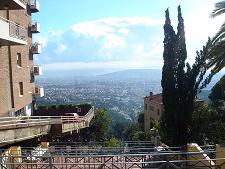
After about another 15 minutes, you reach the entrance to the little park that holds the archaeological excavation of the Iberian Village of Puig Castellar. At the base of the excavation site a nice little area has been developed, including stone benches and a wooden deck that stretches out from the hill. This is an excellent spot for taking in the magnificent views of the Besos river, Santa Coloma de Gramenet, Badalona, Barcelona, and, of course the Mediterranean.
.
Once you walk through the gate and onto the grounds, there are several signs in Catalan, Spanish and English that cover the history of the indigenous Iberian people, outline the fortified village that was located here some 2,500 years ago, mention the archaeological discoveries made at the beginning of the 20th century and describe the preservation of the site. For example, the signs let visitors know that the remains of the village were discovered by Ferran de Segarra in 1902 and that relics from the bed are preserved in the Museum of Archeology of Catalonia in Barcelona and at the Torre Balldovina Museum in Santa Coloma de Gramenet.
.
After reading about the site, head up to the crest of the hill for a walk through the ruins. Signs in Catalan point out the remains of defensive constructions, a water system and the grid of streets, among other things. Structurally the village had an elliptical form, consisting of three longitudinal streets with lined with several structures. It is estimated that more than 200 people lived there. The village economy was based on agriculture, animal husbandry, metallurgy, textiles and trade.
.
The lower section of the town was defended by a wall of stone and clay, the remains of which are easy to spot. The dwellings, which date from the 4th and 2nd centuries BC, were small -- only one or two rooms -- and were built of granite and slate, with roofs believed to have been made of branches and mud. One has been re-built, so that visitors can look inside for a glimpse of what life around the hearth must have been like.
.
At the very top of the hill is a very simple little belvedere-like shelter for sitting and absorbing the surroundings, from the ancient at your feet, to the modern kilometers below.
.
Chao amig@s,
.
Carloz
.
P.S. The Serralada de Marina park website has a nice little walking itinerary laid out from the Balldovina Museum (which is near the center of Santa Caloma de Gramenet) to Puig Castellar.
Monday, March 3, 2008
From modern Barcelona to an ancient Iberian village (Pueblo Iberico) - Part 1

Another of my other favorite day trips out of the city is to the archaeological remains of an ancient Iberian village, today called Puig Castellar, which sits atop Turó del Pollo, a hill overlooking one of Barcelona's neighboring cities: Santa Coloma de Gramenet.
.
By simply hopping on the metro and taking a nice walking out of Santa Coloma towards the hills, within a couple of hours you can be walking around the ruins of a 4th Century BC village and taking in magnificent views of the Mediterranean, Santa Coloma, Badalona and Barcelona. Here's the first part of the route:
.
An appropriate starting point is Barcelona's Plaza Urquinaona, since it lies at the foot of Via Laietana, the street that takes its name from the ancient Iberian people who inhabited this region thousands of years ago. From here take the Red line of the Metro to the Santa Coloma de Gramenet station. Take the Plaça Vila exit and you will be at the foot of one of the city's main squares, which holds the city hall building. (See photo above.) While none of the sidewalk cafes here are outstanding, most can be counted on to provide pleasant tapas, simple sandwiches and such. I suggest sitting here for a while to soak up the atmosphere and rest up before the next phase of the journey, which involves a walk through narrow neighborhood streets to a broad avenue several blocks away.
.
Next head north along quaint little Sant Carles Street, which runs along the west side of the plaza. On this quiet street you can find a tiny art museum, a small park (which holds another sidewalk cafe) a Japanese/Chinese restaurant that seems to be pretty popular (although I've never tried it myself), a little bread shop and many typical residences. Sant Carles ends at Sant Jeroni Street, where you turn to your right, then take an immediate left to go down one block onto Dr. Ferran Street. This street will take you to Pallaresa Avenue, which has a good selection of sidewalk cafes and restaurants lining the southeast side. The avenue itself is so wide that a public park stretches out in between its lanes.
An appropriate starting point is Barcelona's Plaza Urquinaona, since it lies at the foot of Via Laietana, the street that takes its name from the ancient Iberian people who inhabited this region thousands of years ago. From here take the Red line of the Metro to the Santa Coloma de Gramenet station. Take the Plaça Vila exit and you will be at the foot of one of the city's main squares, which holds the city hall building. (See photo above.) While none of the sidewalk cafes here are outstanding, most can be counted on to provide pleasant tapas, simple sandwiches and such. I suggest sitting here for a while to soak up the atmosphere and rest up before the next phase of the journey, which involves a walk through narrow neighborhood streets to a broad avenue several blocks away.
.
Next head north along quaint little Sant Carles Street, which runs along the west side of the plaza. On this quiet street you can find a tiny art museum, a small park (which holds another sidewalk cafe) a Japanese/Chinese restaurant that seems to be pretty popular (although I've never tried it myself), a little bread shop and many typical residences. Sant Carles ends at Sant Jeroni Street, where you turn to your right, then take an immediate left to go down one block onto Dr. Ferran Street. This street will take you to Pallaresa Avenue, which has a good selection of sidewalk cafes and restaurants lining the southeast side. The avenue itself is so wide that a public park stretches out in between its lanes.
.
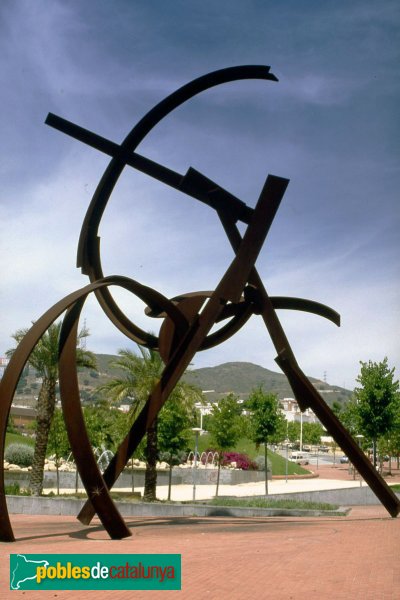
Named Europa Park, this urban space opened in 1992, the year of the Barcelona Olympics. Extending from the Besos River to the hillsides, it consists of more than 59,000 square meters of greenery, walkways, sport zones and playgrounds. It's a place where people stroll, lie on the grass, do a little exercise or sit on a bench while enjoying the quiet that results from having contained the highway that runs through the neighborhood underground, rather than above ground. There are also some interesting sculptures in the park, including Olympia, a jumble of straight and curvilinear iron pieces, by a Swiss artist named Paul Suter.
.
Eventually, you need to head over to the other side of the avenue, where Dr. Ferran Street becomes Puig Castellar Avenue, to begin the uphill walk into the neighborhood below Puig Castellar and the surrounding hills. But this is where I will leave you now and take up again in Part II of my description of this day trip.
.
Hasta entonces amig@s,
.
Carloz
.
Eventually, you need to head over to the other side of the avenue, where Dr. Ferran Street becomes Puig Castellar Avenue, to begin the uphill walk into the neighborhood below Puig Castellar and the surrounding hills. But this is where I will leave you now and take up again in Part II of my description of this day trip.
.
Hasta entonces amig@s,
.
Carloz
Wednesday, August 15, 2007
From the seaside to the hillside - Part 3 (Vallvidrera)
In my opinion, Vallvidrera, which is perched on the crest of the Collserola hills above Barcelona, is one of the city's loveliest neighborhoods. To get there, I usually take the FGC from Plaza Cataluña. (FGC stands for Ferrocarrils de la Generalitat de Catalunya, which is the name of the Catalonian government railway system. Within the city, FGC trains run underground, but outside the city they climb out into the light. Barcelona's transportation system is completely integrated as far as fares and tickets go. So, a pass for the metro is also a pass for the FGC.).
Directly in front of Café Zurich are two entrances to the underground Metro and FGC stations. From either of these two entrances one can enter the FGC station. To get to Vallvidrera take any FGC train except the one to Av. Tibidabo. There are television screens throughout the station indicating when and from which track the next train leaves. Since there are trains leaving every few minutes, it's usually possible to hop on a train immediately. I've never had to wait more than about 5 minutes.
.
After a short ride, it is necessary to get off the train at the Peu del Funicular station and transfer to the modern little funicular that goes up to Vallvidrera. This funicular station is located in an area known as Lower Vallvidrera (Vallvidrera Inferior). The transfer is easy and fast at this little open-air station; and the ride up the hill, in metal and glass cable cars manufactured in Switzerland, offers some excellent views of the city and sea below. The best views are from the seats in the back of the car.
.
The funicular's hours are 4:30am to 12:15am weekdays and 5:30am to 12:45am weekends and public holidays. Cars run every 6 minutes on weekdays and every 10 to 15 minutes on weekends and public holidays.
.
Although one wouldn't know it from the sleekly contemporary appearance of the Peu de Funicular station and cable cars, this line has been in operation since 1906, when the rail line was extended from Sarrià to Lower Vallvidrera. It wasn't until 1998 that the funicular was converted into the totally automated system it is today.
.
There is only one stop between Lower and Upper Vallvidrera: the tiny Carretera de las Aguas (Water Road) station. At this stop it is common to see hikers and bicyclers getting out. However, I usually prefer to ride to the top and then walk down to the Carretera.
.
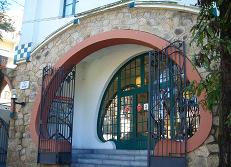
Next comes Upper Vallvidrera and a fantastic remnant of the 1906 line -- the modernist art nouveau Vallvidrera Superior station. Walking around this little jewel of a station, with its voluptuously curved windows and entrance, is like stepping back in time to the era of Gaudi. Constructed in 1905, the station was designed by the architect Bonaventura Conill i Montobbio, who who designed a good number of the buildings in Vallvidrera. Make sure to visit the viewing platform at the back of the station's lobby.
.
From here it is possible to take a city minibus (line 111) to the top of Mount Tibidabo, where a large church sits on top of an amusement park overlooking the city. Since Vallvidrera is actually surrounded by the protected Collserola Natural Park, it is also a great place to start off for a hike in the woody hills. Before doing anything else, however, get to know this quaint little neighborhood a bit.
.
The earliest known reference to Vallvidrera appeared in 987, in a document referring to the church of Santa Maria de Vallvidrera and a Gothic style church by that name was built between 1540 and 1587, and is located in what today is the park of Collserola. In the 14th century the "parish" became a "civil jurisdiction." In 1892, what was then the town of Vallvidrera was annexed by the town of Sarrià, which was then annexed by Barcelona in 1921.
.
Despite this long history, major urban development didn't begin in Vallvidrera until the second half of the 19th century, when the characteristics of the area a¡changed from that of a village to a location for summer homes of the increasingly prosperous citizens of Barcelona. A "modern" road was not built to link it with the city until 1888, when the Vallvidrera to Tibidabo roadway was constructed. In 1901 a tram was inaugurated to link Barcelona, Tibidabo and Vallvidrera. In 1906 the funicular connected the area with Sarria. At this time Vallvidrera became a popular summer residence for wealthy Barcelonans. Today it is a handsome residential neighborhood with the characteristics of a small, prosperous town.
.
Directly across from the funicular station is Plaza Pep Ventura. Walking around the little square and the streets surrounding it, one is surrounded by superb views. Walk to one side of the plaza and gaze over the tiled roofs of lovely little houses out onto the green valley below and the Montserrat massif looming in the west. Most of the houses date to the early 1900s, as can be observed by the years inscriptions on the gables. (One house even has a Catalan poem inscribed on it!)
.
Head to the the east along C/ de Queralt, which changes from a street to a series of pedestrian steps. Look between the houses to the left for some great vies of the city. At the foot of the steps you will find the main square of the neighborhood, Plaza de Vallvidrera. Stop in at for a coffee and a sandwich at Bar Josean, which has a back sitting room with an incredible view of Barcelona and the Mediterranean. Nearby, the Can Trampa restaurant doesn't offer much of a view but is a good little spot for lunch or dinner. The plaza also hosts a modernist style wine and cheese shop, as well as a bread shop and a convenience store. One block to the north is the Mercado del Vallvidrera at C/ dels Reis Catolics 2, which sadly is set to close.
.
Walk back to Pl. Pep Ventura along C/ de les Alberes for more fantastic views of the valley leading to Montserrat. Once back at the Plaza, walk up the "street" stairs of C/ dels Algarves. More lovely houses, this time a mix of old and new, will lead you to the Hotel Vallvidrera, dating from the 1900s. Today it is a well maintained senior citizens' residence. It is easy to imagine what the place must have looked lime in its heyday.
.
At this point C/ dels Algarves rejoins C/ de les Alberes. Continue east along Alberes a bit and on the right you will find a steep "stair street" called Escales del Font del Mont carved into the side of the hill. This is one of the ways to reach the Carretera de la Aguas (Water Road) below. At the bottom of the stairs take a right on Torrent de la font del Mont and walk down until it ends at the Carretera de las Aguas. Once you reach this gravel road, head to the left and walk for about 10 minutes to find yourself in a peaceful wooded area overlooking the panorama of the city and the sea. Breathe in the fresh air, have a seat on one of the benches built alongside the road, walk through the trees above the road -- in other words, relax.
.
When you are ready to return to the buzz of the city below, head back in the direction you came, and after about a 5 minute walk beyond the entrance to Torrent de la Font del Mont, where you entered the road, you will find the Carretera de las Aguas (Water Road) funicular station. On the ride down you can enjoy one more glimpse of Barcelona stretching from the hillside to the seaside.
.
Carloz
Wednesday, July 25, 2007
Back to Barceloneta Park for a Moondance

I just got back from a very low-tech, high-energy festival in Barceloneta Park. DÍA FUERA DEL TIEMPO : PAZ ES CULTURA! (Day Out of Time: Peace is Culture) started at 10am this morning, but since today was a work day, I couldn't get there until this evening. It's still going on, but because of tomorrow being a work day, I had to come home. Ahh, but it was a nice interlude from the work week while it lasted.
.
The event had music, massages, meditation, books, vegetarian food and non-alcoholic beverages. There was no charge for anything, simply a few boxes put out for donations.
.
When I arrived HIJOS DE LA CALLE (Children of the Street), a "fusion rumba electrohop" group was just finishing up on a stage set up inside the wrought-iron forum on one side of the park. I really didn't hear enough of them to judge, but what I did hear sounded interesting.
.
Between musical sets, I walked around, said hello to people I knew and was introduced to others, while looking at the items on display at booths around the circle -- books, magazines, candles, incense, fabric, pillows, sign-up sheets for various volunteer opportunities, etc. Then I got something to eat from the food stand and joined the hundreds of people sitting and lying around inside the circle, as the sun went down.
.
Seated in the crowd were some of the amateur percussionists that gather in the park pretty regularly. They beat their bongos, banged their drums and battered on other things to entertain us while we waited. (As a matter of fact, spontaneous percussion sessions like this are a regular occurrence here and in Ciutadella Park on Sunday evenings. There are usually spinners and jugglers and such along with them.)
.
Next was a pretty good Spanish rap group named SURIKATOS. (No translation for this one!) The best thing about them was the back-up vocalist, who sang one and a half solos. Her voice was incredible -- reminiscent of Billie Holiday and Erika Badu and Celia Cruz. Unfortunately she is not mentioned on the duo's web site. WHO WAS SHE?!?!
.
After their performance came DANZA DE LA CORAZÓN ÚNICO. (One Heart Dance.) This started about an hour later than scheduled, like everything else did, but it was worth the wait. Led by North American Roy Little Sun, this Hopi dance around a little bonfire in the middle of the circle was a great community experience and good exercise, as well!
.
Here is a description of the dance I've adapted from Little Sun's blog that will give you a pretty good idea of what I just experienced:
.
"1. Dancers circle counter-clock-wise around the pattern while inviting 'all our relations' to be part of the dance and then enter from the East. Continue dancing until there is complete synchronicity. It may take four or up to nine rounds. Then exit from the East and again circle counter-clock-wise to then enter from the South with the same sequence, until all the four directions have been initiated.
.
2. The last gate to be opened is that of the North. Upon the exit the dancers circle again counter-clock-wise and realise that the in-out-weaving have created the Union, so that the pattern can unfold to become the Circle of Hearts.
.
3. Upon making the full circle the dancers stop circling and together face the Centre.
.
4. Upon the sign of the one who leads the dance the Circle moves towards the Centre for all the dancers to bless the Fire, that has been placed at the Centre. Then the dancers move backwards to the circle they had. This routine is done four times.
.
5. Having come back the fourth time to the Circle, the drum(s)/music stops and everyone contemplates on the culmination of the dance into the Centre. The duration may last as long as the attained collective consciousness allows it to be.
.
6. The dance-leader goes to the Centre...
.
7. The ceremony ends with everyone holding hands while together taking three deep breaths, signifying the sharing of the experience with the world. Thank 'all our relations to be part of the dance and until next time'."
.
The main difference in tonight's version was the rhythmic hand-clapping that the Spaniards couldn't resist adding about midway through.
.
Reluctantly, I had to tear myself away after the dance, but what a great way to end my time there! Heading out of the crowd, I noticed that little groups of picnickers were spread out along the grass, enjoying the activities in the circle from a distance.
.
In one small group, a fellow was strumming a little harp for his friends. As I entered Barceloneta, Roy Little Sun's calm voice mingled with the music of the harp in what sounded like a call to another dance.
.
Goodnight amig@s,
.
Carloz
.
The event had music, massages, meditation, books, vegetarian food and non-alcoholic beverages. There was no charge for anything, simply a few boxes put out for donations.
.
When I arrived HIJOS DE LA CALLE (Children of the Street), a "fusion rumba electrohop" group was just finishing up on a stage set up inside the wrought-iron forum on one side of the park. I really didn't hear enough of them to judge, but what I did hear sounded interesting.
.
Between musical sets, I walked around, said hello to people I knew and was introduced to others, while looking at the items on display at booths around the circle -- books, magazines, candles, incense, fabric, pillows, sign-up sheets for various volunteer opportunities, etc. Then I got something to eat from the food stand and joined the hundreds of people sitting and lying around inside the circle, as the sun went down.
.
Seated in the crowd were some of the amateur percussionists that gather in the park pretty regularly. They beat their bongos, banged their drums and battered on other things to entertain us while we waited. (As a matter of fact, spontaneous percussion sessions like this are a regular occurrence here and in Ciutadella Park on Sunday evenings. There are usually spinners and jugglers and such along with them.)
.
Next was a pretty good Spanish rap group named SURIKATOS. (No translation for this one!) The best thing about them was the back-up vocalist, who sang one and a half solos. Her voice was incredible -- reminiscent of Billie Holiday and Erika Badu and Celia Cruz. Unfortunately she is not mentioned on the duo's web site. WHO WAS SHE?!?!
.
After their performance came DANZA DE LA CORAZÓN ÚNICO. (One Heart Dance.) This started about an hour later than scheduled, like everything else did, but it was worth the wait. Led by North American Roy Little Sun, this Hopi dance around a little bonfire in the middle of the circle was a great community experience and good exercise, as well!
.
Here is a description of the dance I've adapted from Little Sun's blog that will give you a pretty good idea of what I just experienced:
.
"1. Dancers circle counter-clock-wise around the pattern while inviting 'all our relations' to be part of the dance and then enter from the East. Continue dancing until there is complete synchronicity. It may take four or up to nine rounds. Then exit from the East and again circle counter-clock-wise to then enter from the South with the same sequence, until all the four directions have been initiated.
.
2. The last gate to be opened is that of the North. Upon the exit the dancers circle again counter-clock-wise and realise that the in-out-weaving have created the Union, so that the pattern can unfold to become the Circle of Hearts.
.
3. Upon making the full circle the dancers stop circling and together face the Centre.
.
4. Upon the sign of the one who leads the dance the Circle moves towards the Centre for all the dancers to bless the Fire, that has been placed at the Centre. Then the dancers move backwards to the circle they had. This routine is done four times.
.
5. Having come back the fourth time to the Circle, the drum(s)/music stops and everyone contemplates on the culmination of the dance into the Centre. The duration may last as long as the attained collective consciousness allows it to be.
.
6. The dance-leader goes to the Centre...
.
7. The ceremony ends with everyone holding hands while together taking three deep breaths, signifying the sharing of the experience with the world. Thank 'all our relations to be part of the dance and until next time'."
.
The main difference in tonight's version was the rhythmic hand-clapping that the Spaniards couldn't resist adding about midway through.
.
Reluctantly, I had to tear myself away after the dance, but what a great way to end my time there! Heading out of the crowd, I noticed that little groups of picnickers were spread out along the grass, enjoying the activities in the circle from a distance.
.
In one small group, a fellow was strumming a little harp for his friends. As I entered Barceloneta, Roy Little Sun's calm voice mingled with the music of the harp in what sounded like a call to another dance.
.
Goodnight amig@s,
.
Carloz
Monday, July 23, 2007
Barceloneta Park (El Parque de la Barceloneta / El Parc de la Barceloneta)

The little sea front Barceloneta Park marks the transition from the old neighborhood of Barceloneta to a new one called Villa Olimpíca. It's a relatively new park located on a site that used to be home to Barcelona's gas company. In fact, a lovely old building that was once part of the complex still sits there, looking somewhat forlorn and abandoned on the park's western side. Towards the park's northeastern end there is a structure dating from 1905: a stone water tower designed by architect Josep Domenech i Estapa. On the eastern side stands a wrought iron circular stage, where musical events are often held.
.
The park is laid out along three large areas: the first one extends from its city side at C/ Doctor Aiguader to its sea side at Paseo Maritimo; the second, begins with a direct access point from within the neighborhood of Barceloneta, near the old gas company building, that leads to large curved slopes of greenery with walkways running along them; the third area consists of an enclosed soccer field with an elevated street-wide ramp that was intended to be a foot bridge to Ciutadella Park. Instead, it just ends in mid-air!
.
The park is laid out along three large areas: the first one extends from its city side at C/ Doctor Aiguader to its sea side at Paseo Maritimo; the second, begins with a direct access point from within the neighborhood of Barceloneta, near the old gas company building, that leads to large curved slopes of greenery with walkways running along them; the third area consists of an enclosed soccer field with an elevated street-wide ramp that was intended to be a foot bridge to Ciutadella Park. Instead, it just ends in mid-air!
.
But the view from there is wonderful -- the soccer field and the whole of the park to the south; the medical complex to the east; Ciutadella Park to the north, with Mount Tibidabo in the background; and the gleaming glass high-rise that is the new gas company buliding to the west. The top of this ramp is a nice point to watch the sunset behind Mount Tibidabo, as I did earlier this evening.
.
Oddly enough, Barceloneta Park is hardly ever crowded, no matter how packed the beach and the Paseo Maritimo directly in front of it seem to be. Therefore, most of the people who make use of the park are local residents. Aside from enjoying a picnic on the grass or a snooze on a bench, visitors can also have a coffee or drink at the nice little chiringuito with a sea view that is operated by the city's Parks and Gardens Department. If you like a little more activity, like most parks in Barcelona, this one has a children's play-ground, a few outdoor ping-pong tables, a basketball hoop, pitches to play a bowling-ball type game called "petanca" in Spanish and "botxe" in Catalan, as well as a doggy play-ground -- a fenced in area where dogs can run free.
.
Other interesting aspects of the park include its unusual mix of pine and mimosa trees, the abundance of wild parakeets that make the park their home and the statue of Simon Bolivar looking like he's ready to head out to the sea. This last was a gift from the government of Venezuela and was unveiled by Spain's King Juan Carlos at the park's 1996 inauguration.
.
Well, that's a bit about Barceloneta Park, a nice spot to have a little rest away from the crowd.
.
I hope you get to enjoy it someday.
.
Chao amig@s,
.
Carloz
.
Oddly enough, Barceloneta Park is hardly ever crowded, no matter how packed the beach and the Paseo Maritimo directly in front of it seem to be. Therefore, most of the people who make use of the park are local residents. Aside from enjoying a picnic on the grass or a snooze on a bench, visitors can also have a coffee or drink at the nice little chiringuito with a sea view that is operated by the city's Parks and Gardens Department. If you like a little more activity, like most parks in Barcelona, this one has a children's play-ground, a few outdoor ping-pong tables, a basketball hoop, pitches to play a bowling-ball type game called "petanca" in Spanish and "botxe" in Catalan, as well as a doggy play-ground -- a fenced in area where dogs can run free.
.
Other interesting aspects of the park include its unusual mix of pine and mimosa trees, the abundance of wild parakeets that make the park their home and the statue of Simon Bolivar looking like he's ready to head out to the sea. This last was a gift from the government of Venezuela and was unveiled by Spain's King Juan Carlos at the park's 1996 inauguration.
.
Well, that's a bit about Barceloneta Park, a nice spot to have a little rest away from the crowd.
.
I hope you get to enjoy it someday.
.
Chao amig@s,
.
Carloz
Subscribe to:
Posts (Atom)